Guide
How to find models for your clothing brand (and when you don’t need one)
Fit model, photo model or campaign face; yourself, friends, freelance or agency; the casting call, the rates, the release and the shoot day. And the route that needs no booking at all.

 By Elena Varga
 · Reviewed by Sofia Moretti |Fact-checked|15 min read
Key takeaways
- 1Decide the job before the person: a fit model checks the pattern, a photo model sells the garment, a campaign face fronts a launch. Most small brands need the second.
- 2Model fees “range widely”, Shopify’s pricing guide says, and a photographer adds $500 to $3,000 a day. Get the rate, the usage and the release in writing before the day.
- 3For product pages, an AI model can wear your real garment from a flat photo: 500+ models, your own model or yourself, the same one across the collection. 60 photos are $15 at Tryly’s lowest rate.
10 free photos, no card. Photos as low as $0.25 each.
On this page+
How do you find models for a clothing brand?
The short answer
Models for a clothing brand come from yourself, your friends and customers, freelance models found through local casting groups, social media and photography communities, and agencies. Which is right depends on the job. Product pages need the garment shown clearly on a body; a campaign needs a face. And for product pages you may not need to book anyone: Tryly puts your real garment on one of 500+ models, your own model or yourself, from a flat photo, with 10 free photos to test it.
Fit model, photo model or campaign face: which do you need?
The short answer
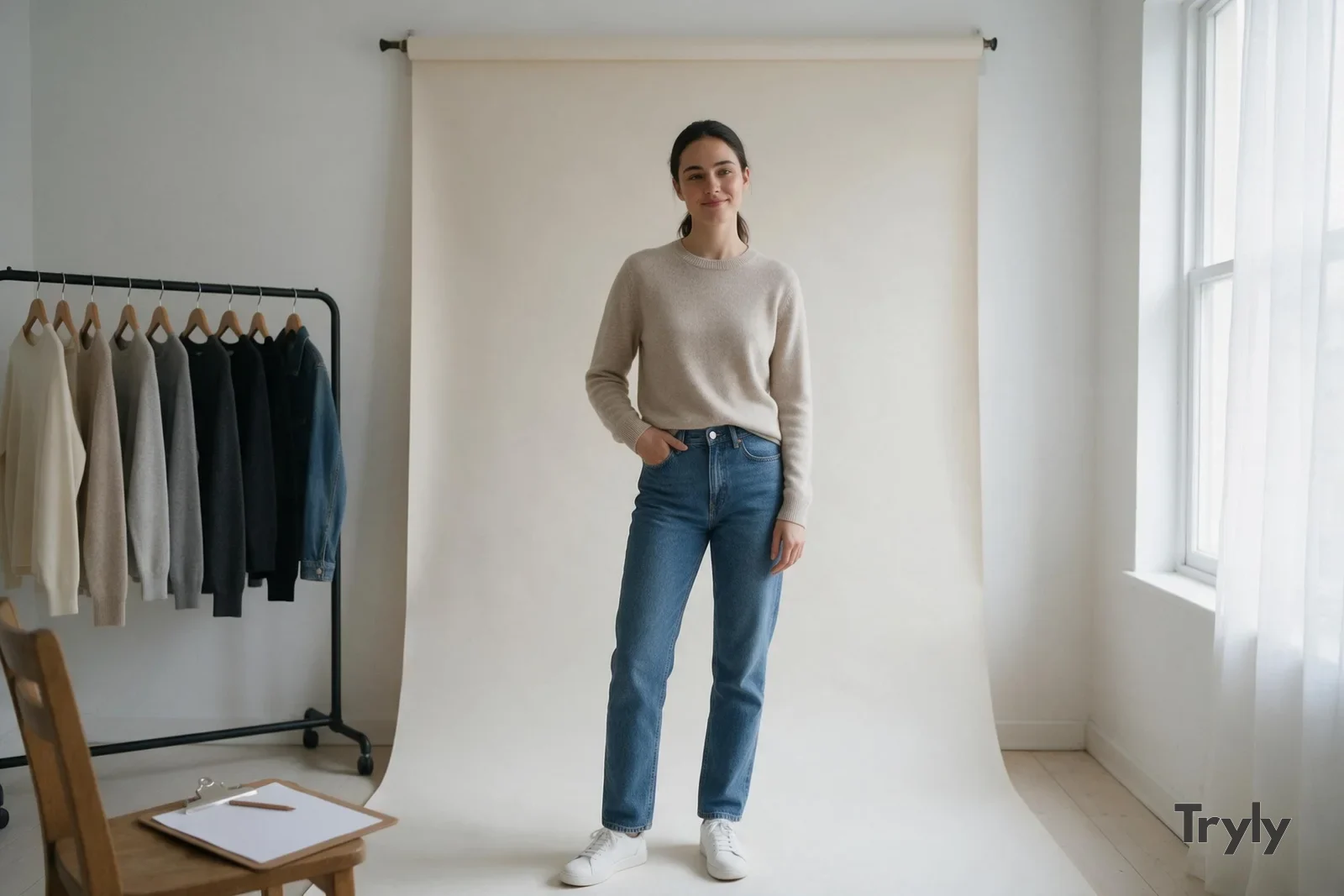
Three different jobs get called “a model”: a fit model tries on samples so you can fix the pattern, a photo model wears the finished garment for product pages and the lookbook, and a campaign face fronts ads, video and launches. Most small brands need the second, sometimes the first, and rarely the third.
Fit model
Tries on samples so you can fix the pattern: where it pulls, where the sleeve ends. Cast by measurements against your size chart, not by looks.
Photo model
Wears finished pieces for product pages, the lookbook and social. What matters: the garment reads clearly, on the same person across the collection. An AI model can also do this job.
Campaign face
Fronts a launch: video, ads, press, events. You pay for presence and longer usage.
Fix the fit before the photo: a sample that pulls at the button pulls in every photo, and no model or retouching hides it. The sampling steps are in starting a clothing brand.
Where do small clothing brands find models?
The short answer
Yourself, friends and customers, freelance models, an agency, trade-for-photos, or an AI model wearing your real garment. The cheap routes cost time and reliability; the pricier ones buy experience and a face.
| Option | What it costs | The trade-off | Best for |
|---|---|---|---|
| Yourself | Free | Your time on both sides of the camera; matching light and pose across days | Founder-led brands, first drops |
| Friends and customers | Free or a thank-you | Reliability, and how many sizes one circle covers; a release is still needed | Lookbooks, social, a real-customer feel |
| Freelance model | A rate you agree per hour or per day | You do the finding, booking and paperwork | E-commerce and lookbook days |
| Agency model | The model’s rate, booked through the agency | The agency handles booking and paperwork on its terms; read the usage term in the contract before you sign | Campaigns, video, a face for the brand; rarely product pages |
| Trade for photos | The finished photos instead of a fee | Experience varies; say so in the call, and still agree the usage and sign a release | New brands with a photographer friend |
| AI model on your flat photo | As low as $0.25 per photo (Tryly’s lowest rate) | Test your hardest piece with the 10 free photos first | Product pages; a whole collection on one model |
If you are the model, one spot by the same window keeps the collection matching across days.
Friends and customers
People who already like the pieces cost a thank-you and a discount code. Ask your email list and your followers: your buyers are the sizes you sell. Give them what a paid model gets: a date, a shot list, a release and the finished photos.
How do you find a freelance model without an agency?
The short answer
Freelance models work without an agency, so you book them directly, through local casting groups, social media and photography communities. In the words of the US Bureau of Labor Statistics, they “market themselves to potential clients and apply for modeling jobs directly.”
Local casting groups
Most cities have casting groups on Facebook and community forums. Search “[your city] models” and “[your city] casting”, and read a week of posts to learn the going rate.
Social media and photography communities
Search hashtags built from your city and “model”, and see who nearby photographers and small brands tag. A model who has shot e-commerce before knows the pace: many garments, three poses, no fuss. And ask your photographer: most keep a list of models they trust.
How do you write a model casting call?
The short answer
A casting call is a short job ad: who you are, what you are shooting, when and where, who you are looking for, what you pay, how the photos will be used, and exactly what to send to apply. Vague calls attract vague replies; a specific call does the filtering for you.
- Who you are. The brand name and a link that proves the brand exists.
- The job. E-commerce, lookbook or campaign, and how many pieces.
- When and where. The date, the time window and the place.
- Who you are casting. The sizes you need by name, and any height or age range.
- The pay. A rate per hour or day, or the trade, and when it is paid.
- Usage. Where and for how long the photos will be used; a release comes before the shoot.
- How to apply. What to send, and by when.
Safety and professionalism
- Post under the brand name, with a link, and never ask for swimwear or underwear photos unless that is the product.
- Shoot in a professional space with a second person on set, welcome a chaperone, pay when you said you would, and cast adults: under 18 means a parent or guardian on the release.
How much does a model cost?
The short answer
There is no single rate. Shopify’s product photography pricing guide says model fees “range widely”, depending on the talent’s experience, agency representation and expertise, and puts the photographer at $500 to $3,000 per day on top. For scale, the US Bureau of Labor Statistics puts the median hourly wage for models at $23.30: a wage, not a booking rate.
| Line | What to budget | Source |
|---|---|---|
| Model | A rate per hour or per day, quoted in writing with the usage. | Your own quotes |
| Agency model | The model’s rate, booked through the agency, which takes a portion of the model’s earnings. | BLS |
| Photographer | $500 to $3,000 per day. | Shopify |
| Studio, hair and makeup, styling, retouching, travel | Separate lines; get a quote for each before the day. | Your own quotes |
Shopify puts rush fees at 25% to 200% of the total job, so book the photographer and the model early. And an experienced e-commerce model gets through more garments per hour, which is what sets your cost per photo.
For comparison, a 20-piece drop at three on-model photos each is 60 photos: $15 at Tryly’s lowest rate of $0.25 per photo, with no model, studio or photographer day. The true cost of a fashion photoshoot adds the lines a model rate leaves out, and the product photography cost guide lists hourly rates for freelance and agency models.
What should a model release form cover?
The short answer
A model release is the model’s written permission for you to use their likeness. An ASMP chapter article on releases puts it plainly: if a photo is “used commercially”, whoever uses it “will need a release.” It should say who, which photos, where they may be used, for how long, and what the model gets, and it is signed before the first frame. This is general guidance, not legal advice: laws vary by country and state, so have a lawyer check your form.
- Who. The model’s full legal name and contact details; under 18, a parent or guardian signs.
- Which photos. The photos and video from this shoot, with the date and place.
- Where they may be used. Store, marketplaces, social, paid ads, email, print: the channels you will actually use.
- For how long. Perpetual, or a set term with an end date you put in your calendar.
- Where in the world. Worldwide, or named countries.
- Edits. Cropping, retouching, text overlays, and use beside other products.
- Compensation. The rate or the trade, as full payment for the usage described.
- Signatures and date. Both sign and date it, and both keep a copy.
Send it with the booking confirmation, get it signed before the shoot, and file it with the photos so whoever runs your ads later can find it. With one of Tryly’s 500+ library models there is no release to sign, because the model is not a real person; photos made on a paid plan can be used on your store, in ads and on social media (the usage rights guide has the detail).
How do you cast for sizes and diversity?
The short answer
Cast the sizes you sell, not only the sample size. Buyers want to see the garment on a body like theirs. Choose by measurements against your size chart, state the model’s height and the size worn on every product page, and keep the same model per size across the collection.
- Ask for measurements, not a dress size: bust or chest, waist, hip and height. Sizes differ by brand.
- Cover the ends of your range. If you sell XS to 3XL, photograph the two ends and the middle, and say which size each model wears.
- Match your buyers in age, skin tone and body shape: who actually orders, not who you imagined.
On Tryly, the model library is described as “AI models of all ethnicities, body types, and ages”, so the same flat photos can be shown on more than one body without a second casting.
How do you run the shoot day?
The short answer
Send a brief the day before, work from a shot list per garment, and keep the model comfortable: a private place to change, breaks, and nothing on the day that was not in the brief. A calm set makes better photos, and a model treated well comes back for the next drop.
The brief and the shot list
One page: five reference frames, the poses you need (front, back, side, a detail, one relaxed frame) and what to bring, sent with the call time and the address. On the day, one line per garment, ticked as you go: steam everything first, group pieces by look and shoot the most important first. If the plan changes, ask.
The lookbook frames from the same day can be laid out with the guide to making a fashion lookbook.
When you don’t need a model: the AI option
The short answer
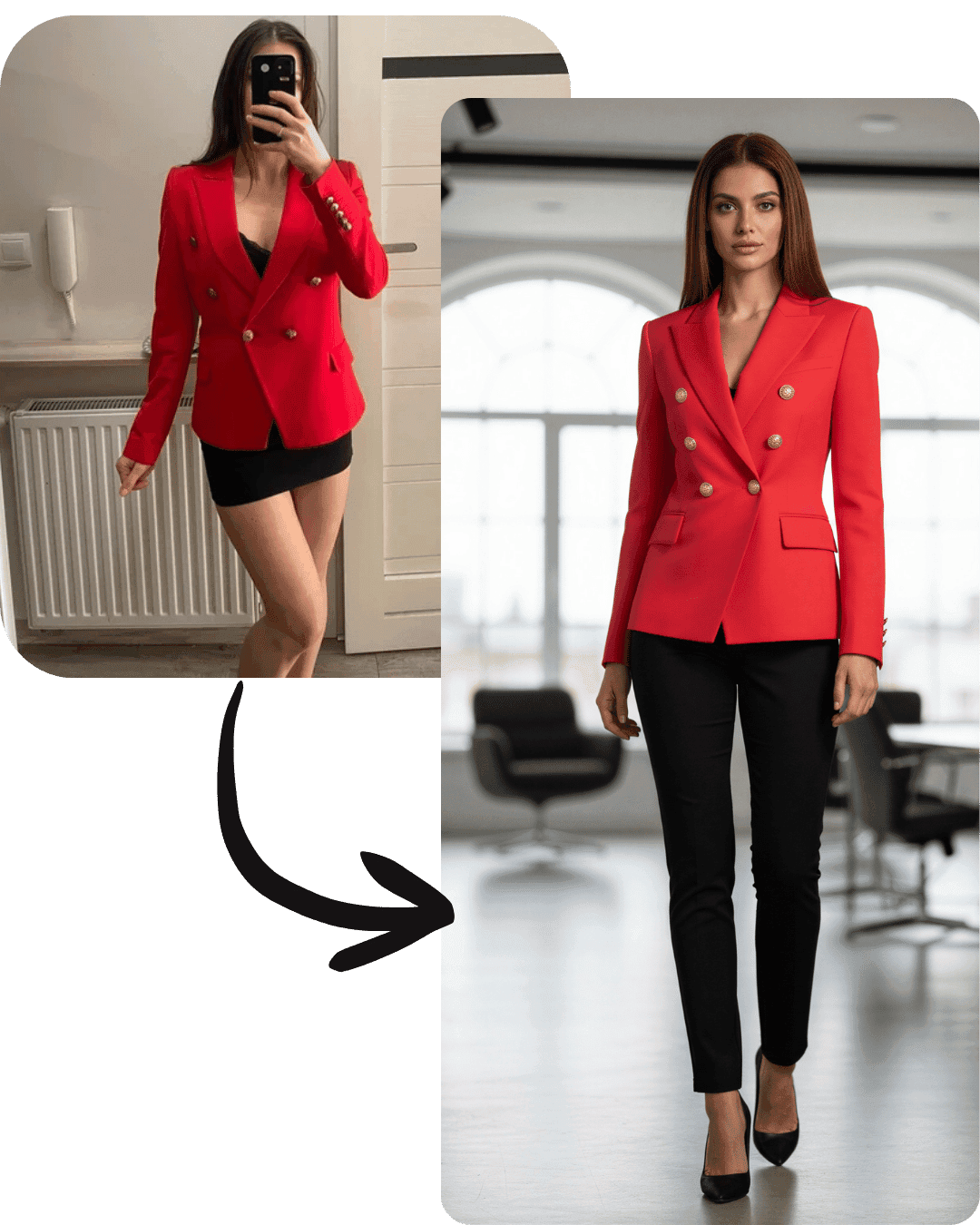
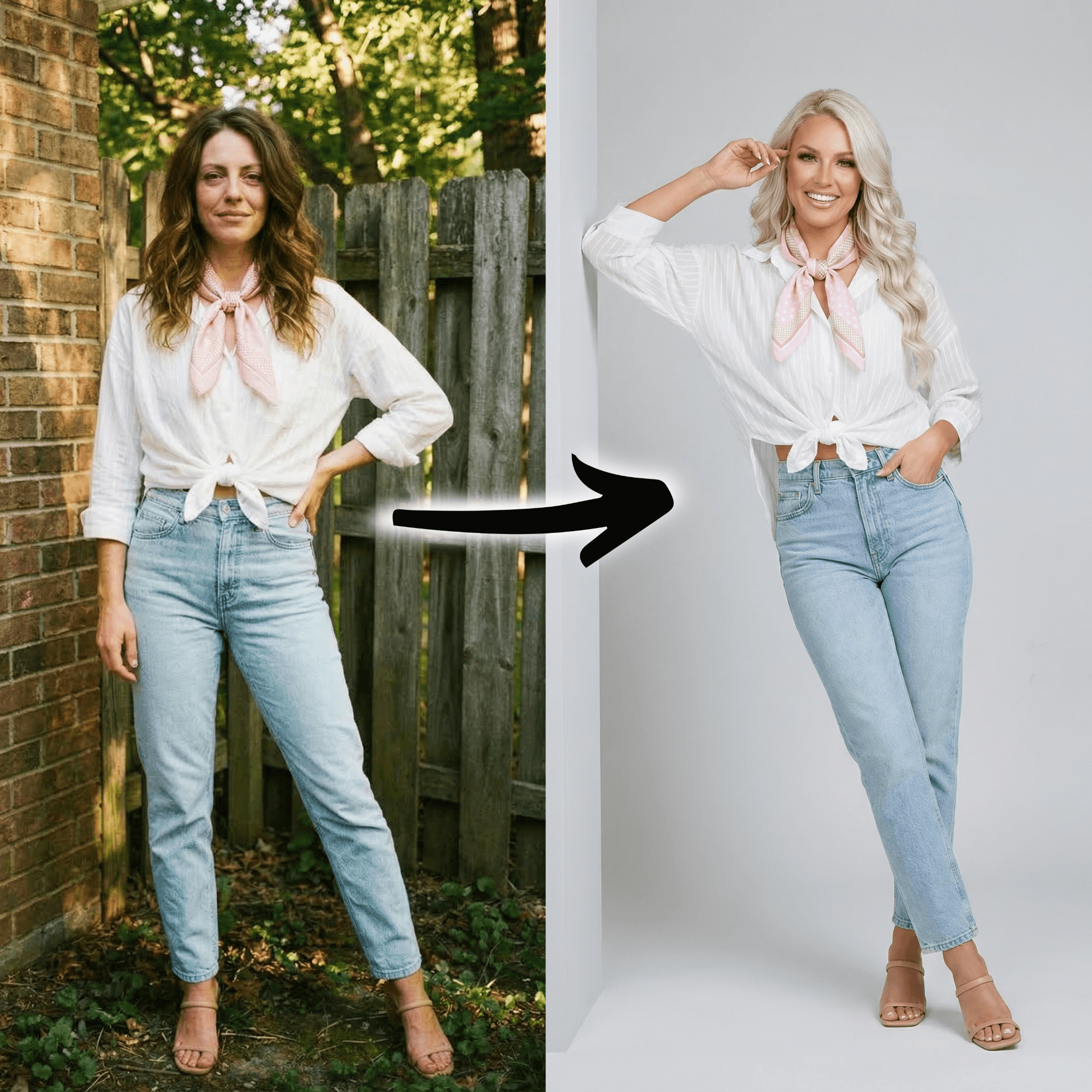
For product pages and lookbooks, an AI model can wear your real garment instead of a booked one. On Tryly you upload a flat, hanger or mannequin photo of each piece, pick one of 500+ models, your own model or yourself, and download the on-model photo in about 15 seconds; the same model can wear the whole collection. Your first 10 photos are free, no card, so you can test it on your own garment before you pay.
.png&w=3840&q=75&dpl=dpl_9QWp893FCGCbUdgS6c3nsvopdtJJ)
How a garment gets onto a model
- Upload one garment’s photo, flat, on a hanger or on a ghost mannequin, with the whole piece in frame on a plain background.
- Choose a model: one of the 500+ in the library, or your own model or yourself from one set of photos. On a paid plan a “Same model” button brings back the model from your last shoot.
- Choose front, back and side poses and a background. The review step shows every choice before anything is spent; one photo is one credit.
- Open the result, check the print and the seams up close, and download.
Screenshots of each step are in how to use AI clothing models; before-and-after pairs from phone photos are on the AI clothing photography page.
The same model across the whole collection
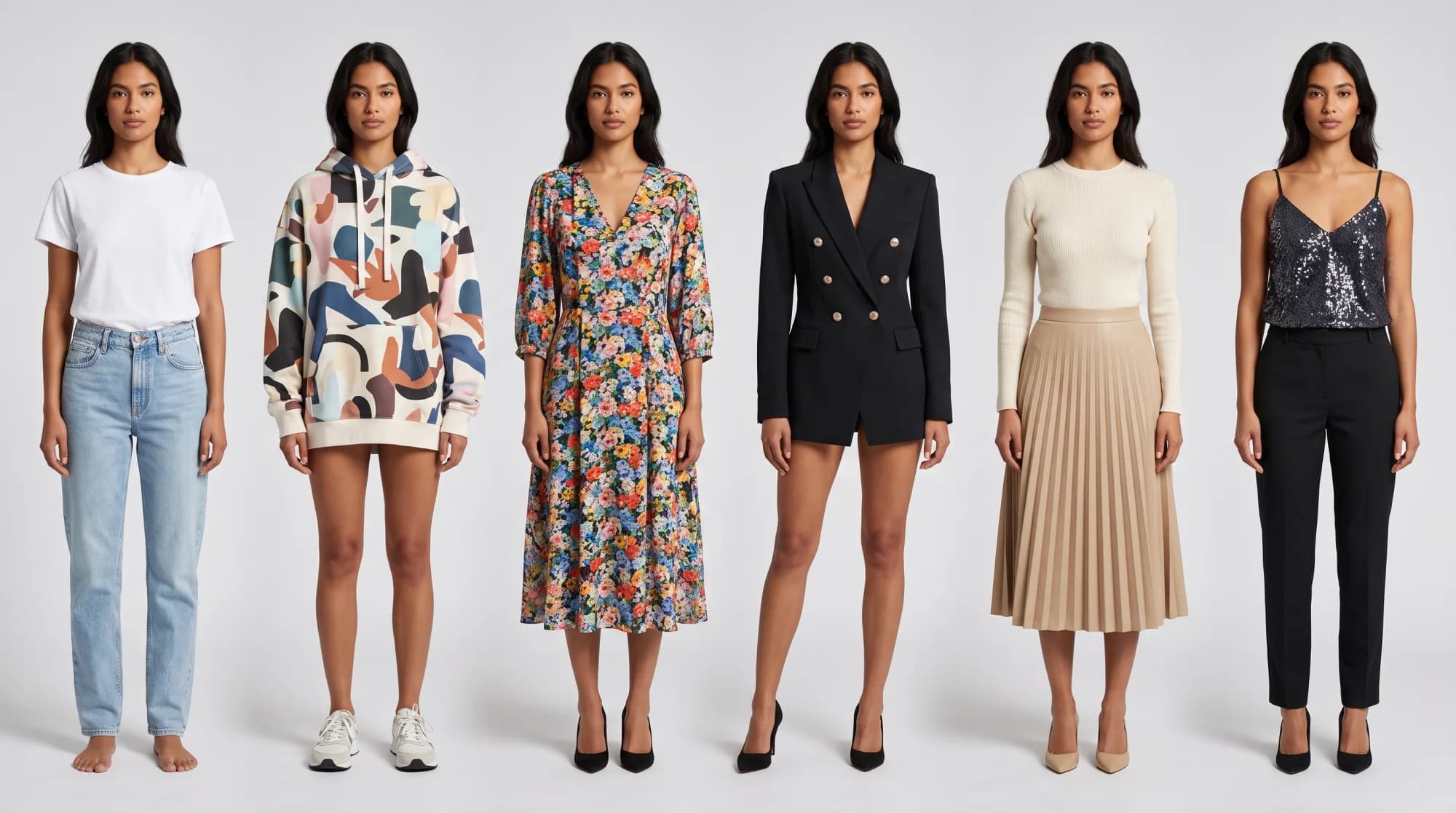
You pick one model and shoot the collection one garment at a time on that person, then run the same photos on a second model for a different audience, with no new photoshoot. The collection demo shows ten garments on one model, with the flat photo, the on-model view and a close-up for each.
The test that matters
Try it on your hardest garment first.
Sellers judge an AI photo tool on the piece most likely to go wrong: a print, a logo, sheer fabric or a detail that has to sit exactly right. Check the result at full size before you publish it. Here: a navy sequin camisole with thin straps, photographed flat beside black tailored pants.
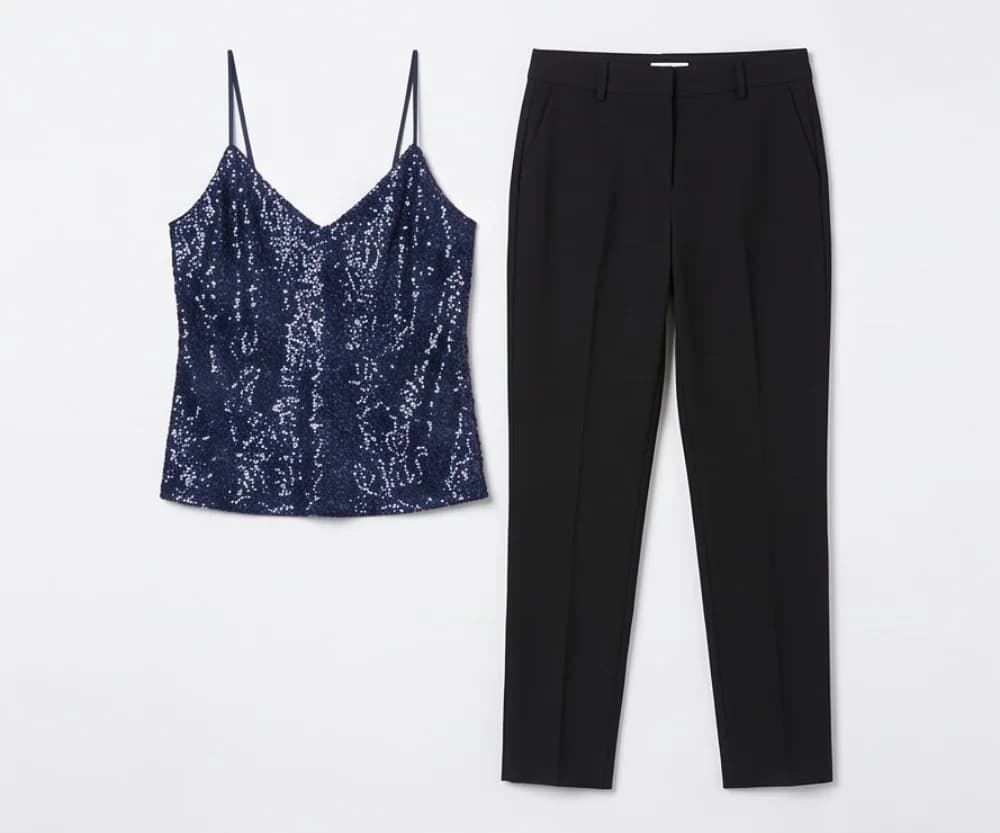
01 Product photo
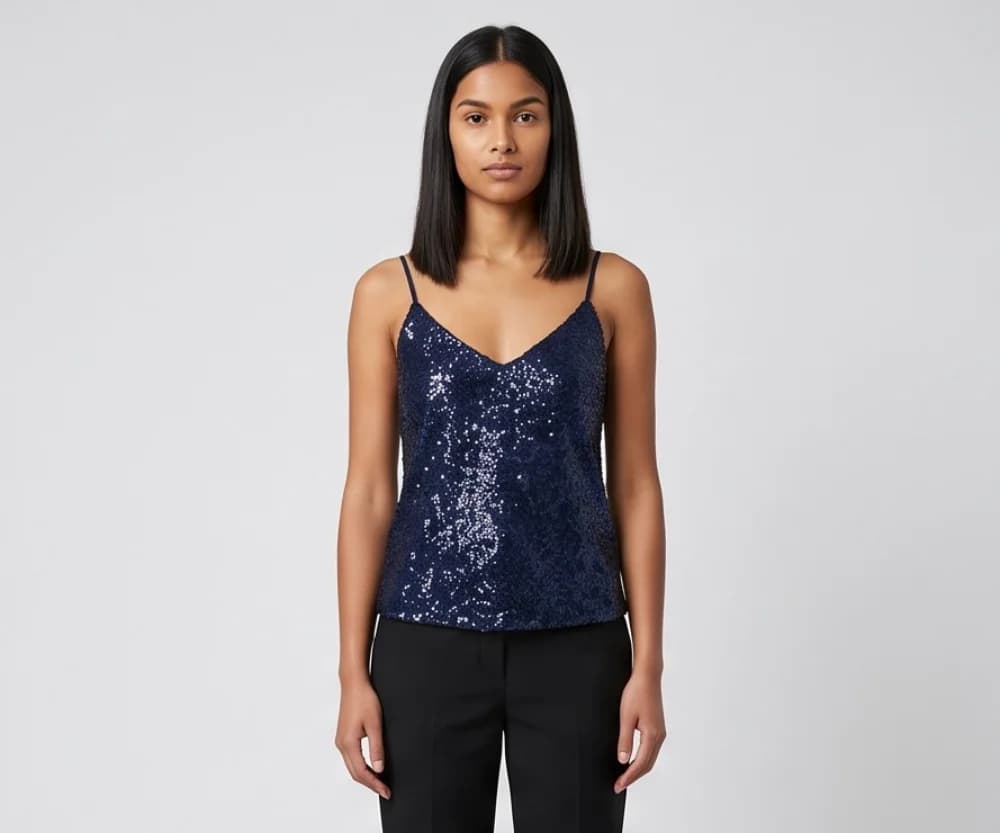
02 On the model
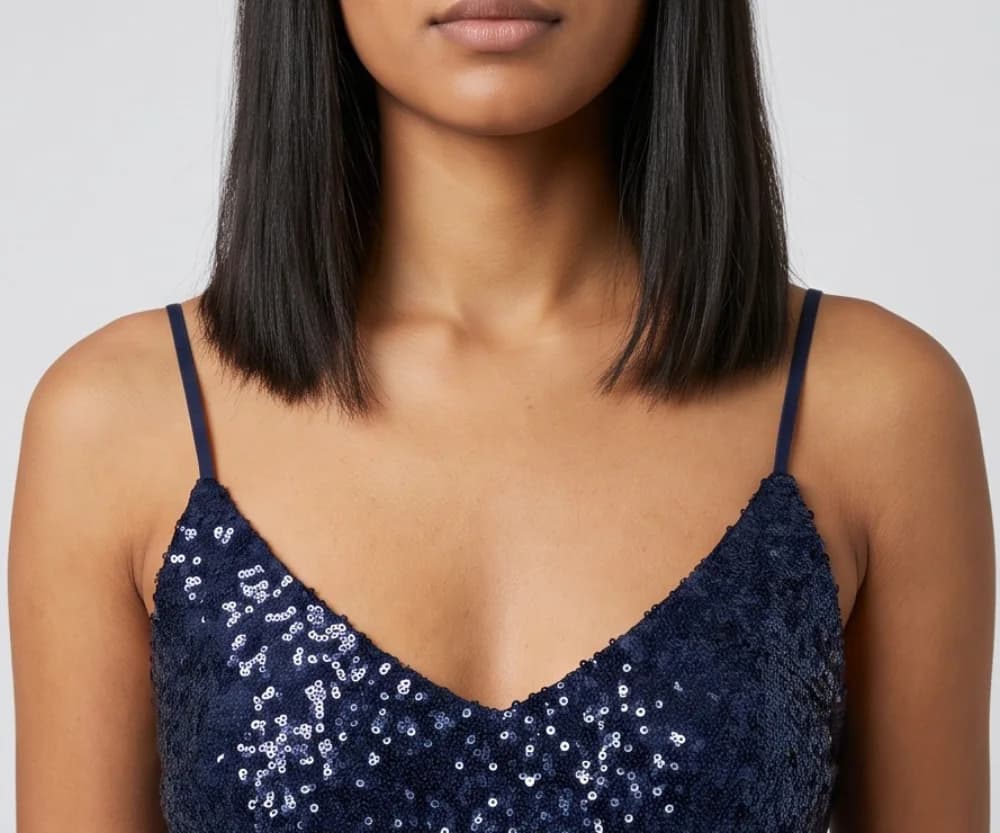
03 Full-size check
10 free photos, no card.
Shoes, bags, hats, watches and jewelry go on models the same way.
When should you still book a human model?
The short answer
Book a person when the job is the person: campaign video, a brand ambassador who is the face of the label, live events and press. The casting, the rate, the release and the brief above still apply, and the product pages can stay on the same AI model in between.
- Campaign video: a walking, talking person in your clothes. Ask for the video rate separately and budget it as its own line.
- A brand ambassador: someone whose own audience buys because it is them. A relationship and a contract, not a casting call.
- Live events and press: pop-ups, markets, a runway slot and a buyer who asks to see the pieces worn.
A common mix: one paid day a season for the campaign and the video, and product pages made from flat photos on the same model all year. The split is worked through in UGC vs studio vs AI photos.
Questions about models for clothing brands
How much does a model cost for a clothing brand photoshoot?+
There is no fixed price. Shopify’s product photography pricing guide says model fees range widely with experience and agency representation, and puts the photographer at $500 to $3,000 per day. The US Bureau of Labor Statistics puts the median hourly wage for models at $23.30, a wage and not a booking rate. Ask each model for a written rate that includes the usage.
How do I find models for my clothing brand for free?+
Be the model yourself, ask friends and customers, or offer a trade: the finished photos instead of a fee. Post the call to your own followers and email list, since your buyers are the sizes you sell. Even when no money changes hands, have the person sign a release before the shoot.
What is a fit model, and does a small brand need one?+
A person whose measurements match your sample size, who tries on samples so you can fix the pattern before production. You need one whenever you make your own patterns, and a friend whose measurements match your size chart does the job.
What should a model casting call include?+
Who you are with a link, the job, the date and place, the sizes, the pay or trade, the usage, and what to send to apply by a deadline. A specific call filters the replies for you.
Do I need a model release form if the model is a friend?+
Yes. A release is the person’s written permission to use their likeness, and an ASMP chapter article notes that a photo used commercially needs one. A friend signs the same form as a paid model, before the shoot. This is general guidance, not legal advice.
Can I use AI models instead of hiring a model for my clothing brand?+
For product pages and lookbooks, yes. On Tryly you upload a flat, hanger or mannequin photo of the real garment and pick one of 500+ models, your own model or yourself; the same model can wear the whole collection. Photos made on a paid plan can be used on your store, in ads and on social media. As low as $0.25 per photo, and your first 10 photos are free, no card.
Can I be the model for my own clothing brand?+
Yes. It is free and always available. Use a tripod, a self-timer and one fixed spot with the same light so the collection matches. If you would rather not be in every photo, Tryly can put your garments on you from one set of photos of yourself, or on one of 500+ models.
Sources: US Bureau of Labor Statistics, Occupational Outlook Handbook: Models; Shopify’s product photography pricing guide; an ASMP Colorado chapter article on releases. What a release should cover is general guidance, not legal advice. Rates change; check each page before you budget.
Written by
Elena Varga
Head of Content, Tryly Academy
Former e-commerce photo producer who ran catalogue shoots for fashion labels for over a decade. Writes the Academy’s guides.
- 11 years in fashion e-commerce
- 1,200+ catalogue shoots produced
Expert review
Sofia Moretti
Fashion photographer · Expert reviewer
Has shot campaigns and on-model e-commerce for fashion brands for 14 years. Reviews every Academy article for accuracy.
- 14 years in fashion photography
- Campaign and catalogue work across Europe
How we work: every Academy article is written by a specialist, reviewed by a working fashion photographer, and re-checked against its sources when prices or rules change.