Guide
Clothing labels and hang tags: what your brand needs
For new clothing brands about to order their first labels: what US law requires on every garment, the label types, what goes on a hang tag, how to design and make them, and where each one is sewn.

 By Elena Varga
 · Reviewed by Sofia Moretti |Fact-checked|12 min read

Key takeaways
- 1Every US garment label needs fiber content, country of origin and your business name or RN, plus permanent care instructions. Your logo label, size tab and hang tag are branding.
- 2The care label must stay attached and readable for the life of the garment, so wash-test it on a real sample before you order the run.
- 3Photograph the label close up for every product page. On-model shots do not show what is inside the collar, and the close-up shows the piece is finished and yours.
10 free photos, no card. Photos as low as $0.25 each.
On this page+
What does a clothing label need to say?
The short answer
A garment sold in the US needs a label showing its fiber content, country of origin and your business name or RN, plus care instructions that stay on for its whole life. Your woven brand label, size tab, hang tags and price tags are your choice. Plan both before you order, because the required words decide how big your labels are.
The law below comes from the Federal Trade Commission’s own pages. It is general guidance, not legal advice. Still need a design and a maker? Start with starting a clothing brand.
What does US law require on a clothing label?
The short answer
Two sets of FTC rules apply. The Textile and Wool Acts require fiber content, country of origin and the identity of the business responsible. The Care Labeling Rule (16 CFR Part 423) requires care instructions that stay attached and readable for the life of the garment.
| Disclosure | Rule | What it must say | Where |
|---|---|---|---|
| Fiber content | Textile Act (Wool Act for wool) | Generic fiber names and percentages by weight, largest first | A label inside or outside that is easy to find |
| Country of origin | Textile Act | The country where it was made; “Made in U.S.A.” only if made in the US of US materials | Front of a label at the inside center of the neck, on garments with a neck |
| Business name or RN | Textile Act | The full business name of the maker, importer or another business marketing or handling it, or an FTC-issued RN | The same label as fiber content, or another easy-to-find label |
| Care instructions | Care Labeling Rule (16 CFR Part 423) | Washing or dry cleaning, plus bleach, drying, ironing and warnings where needed | Attached permanently, readable for the garment’s useful life |
The rules cover anyone who makes, imports, sells or advertises covered products, including a small online brand. Required words must be in English; other languages may appear alongside.
Fiber content
The FTC’s guide to the Textile and Wool Acts says fibers go by their generic names, in order of weight: “65% rayon, 35% polyester”. A single-fiber piece may say “All Cotton” instead of “100% Cotton”. The FTC also accepts the international names viscose for rayon and elastane for spandex.
Fibers under 5% are listed as “other fiber” unless they do a job, such as 4% spandex for stretch. There is a 3% tolerance for honest manufacturing variation, but not for single-fiber claims: the FTC’s example is a blouse that is 97% silk and 3% polyester, which cannot be labeled “100% silk”.
Buttons, zippers, beads and leather patches are not fiber and stay off the content label. Decorative trim covering no more than 15% of the surface can be left out with the words “exclusive of decoration”.
Country of origin
An imported garment names the country where it was processed or manufactured, in English. “Made in U.S.A.” is only for pieces made completely in the US of US-made materials. A T-shirt sewn in the US from imported fabric says so in one statement, such as “Made in U.S.A. of imported fabric”.
The rule reaches your online store too. The same guide says catalog and internet product descriptions must state clearly that an item was “made in U.S.A.”, “imported” or both, and match the label. Add that line to your product page template.
Your business name or RN
The label names the maker, importer or another business marketing or handling the product, by the full name on its invoices. The FTC says a brand name only counts if it is also the business name. The alternative is a Registered Identification Number, printed as “RN” and the digits.
The FTC’s RN questions page says an RN is optional, since your company business name can go on the label instead. RNs are free, go only to US businesses, and online applications are usually processed within 3 business days or sooner.
Care instructions and care labeling
The FTC’s Care Labeling Rule guide covers makers and importers of clothing, and anyone who directs or controls the manufacturing. If a factory makes your designs to your tech pack, plan on being covered. Shoes, gloves and hats are exempt. A washing instruction covers five elements:
- Washing: by hand or machine, with a water temperature if regular hot water would harm the piece.
- Bleach: “Only non-chlorine bleach, when needed” or “No bleach” if bleach would harm it.
- Drying: by machine or another method, with a temperature only if high heat would harm it.
- Ironing: only if the piece needs regular ironing, or a hot iron would harm it.
- Warnings: such as “Wash with like colors” for a piece that bleeds.
The FTC’s minimum washing instruction is “Machine wash. Tumble dry.”: any temperature, any bleach, no ironing needed. Every instruction needs a reasonable basis and must suit the whole garment, trims and linings included. You cannot write “Dryclean only” without evidence that washing would harm the garment, so wash-test your sample.
A few items need only a temporary care label at the point of sale, such as totally reversible clothing without pockets. Hosiery can carry its care instructions on a hang tag or the package.
Care symbols are optional. If you use them, the FTC says they must be the ASTM symbols, not the similar ISO set used in Europe.
Wool, cashmere and children’s clothing
Anything containing wool falls under the Wool Act, including wool hats that the textile rules otherwise skip. Wool is named with its percentage even under 5%, recycled wool must be called recycled, and “cashmere” has a strict fiber definition; fibers that miss it are labeled wool.
Children’s clothing adds a tracking label. The CPSC’s tracking label FAQ covers products designed and primarily intended for children 12 years of age or younger. For textiles, it says: “Hangtags and adhesive labels are not permanent for these products.” There is no exemption for a small or home-based business.
Selling outside the US
Each market sets its own rules. Start with the official source:
- European Union: Your Europe says the label must be firmly attached and list fiber composition in decreasing percentage order, in the official languages of each country where you sell.
- Canada: the Competition Bureau says fiber content must be in both French and English, and the label must show your company name and mailing address or your CA Identification Number.
Types of clothing labels and tags: which are required?
The short answer
The law requires information, not a particular label: fiber, origin, business name or RN, and care, plus a tracking label on children’s pieces. On a garment with a neck, the origin must sit at the neck, so many brands put it on the main label. Size tabs, hang tags and price tags are branding and retail practice.
| Label or tag | What it is for | Required in the US? |
|---|---|---|
| Main (woven) brand label | Your logo inside the neck or waistband: the label buyers see and remember. | No, unless it also carries required information such as the country of origin. |
| Printed label (satin, polyester or cotton tape) | Softer, text-heavy label for fiber, origin, business name and care. | The usual home for the required information. |
| Care and content label | Fiber content, country of origin, business name or RN, care instructions. | Yes: Textile Act and Care Labeling Rule. |
| Printed neck (tagless) | Brand, size and care heat-pressed or printed straight onto the fabric. | Allowed for care instructions if the print stays permanent and legible. |
| Size tab | A small tab or loop, usually under the main label. | No. It helps buyers, returns and restocking. |
| Hang tag (swing tag) | Brand story, product name, size, price, style number, barcode. | No. It can carry extra care information when packaging hides the label. |
| Price tag or sticker | The selling price, often added by the store itself. | Not required by the FTC textile or care rules. |
| Tracking label (children’s) | Who made it, where and when, and a batch or run number. | Yes, on children’s products and their packaging, under the CPSC. |
The FTC allows all required information on one label and notes that shoppers find fiber content most useful next to the care instructions. A printed care and content label in a side seam, plus a neck label with the country of origin, covers most garments.
What to put on hang tags for clothing
The short answer
A hang tag carries your brand, the product name, size, price, style number or SKU, and a barcode if stores need one. US labeling law does not require hang tags, but anything they say about fiber must be true.
- Front: your logo, often alone.
- Product name or style, color and size.
- Price, or a blank space if boutiques set their own.
- Style number or SKU, plus a barcode if a retailer asks for one.
- One sentence of brand story: who makes it, and why.
- Your website and social handle.
- A QR code to the size guide, care guide or product page.
Fiber claims on apparel hang tags
A hang tag may promote one fiber, such as Pima cotton, without the full content. If the garment contains other fibers too, the FTC says the tag must say something like “See label for the product’s full fiber content”, close to the fiber name and in type at least as large. A tag naming the garment’s only fiber needs no such line.
Barcodes, SKUs and clothing price tags
The GS1 US guide says each variation of each product needs a unique barcode: a T-shirt in three sizes and three colors is 9 variations. Selling only in your own store, an internal SKU on the tag may be enough.
Selling wholesale? Ask each store whether it adds its own price sticker before you print prices. The online boutique guide covers the buyer’s side of wholesale.
How to make clothing labels and custom hang tags
The short answer
Write the required wording, pick a material, design at actual size, request quotes, and approve a proof or sample. Then wash-test it on the garment before the full order. For a few pieces, iron-on or sew-on printed labels and home-printed hang tags work, if the care label survives washing.
Sew-in labels: materials and folds
- Woven: the design is woven in thread. Durable; keep small text bold enough to weave cleanly.
- Printed on satin, polyester or cotton tape: text prints sharply, so it suits long care and content wording. Test that the ink survives washing.
- Heat transfer or screen print: printed on the fabric, with no tag to scratch. The FTC allows printed care instructions if they stay permanent and legible.
The fold decides how a label is sewn: flat on all four sides, end-fold with both ends tucked under, or center-fold into a seam. The FTC allows fiber, business and care details on the back of a label only if one end is free, so buyers can flip it. Country of origin always goes on the front.
Custom hang tags: paper, finishes and attachment
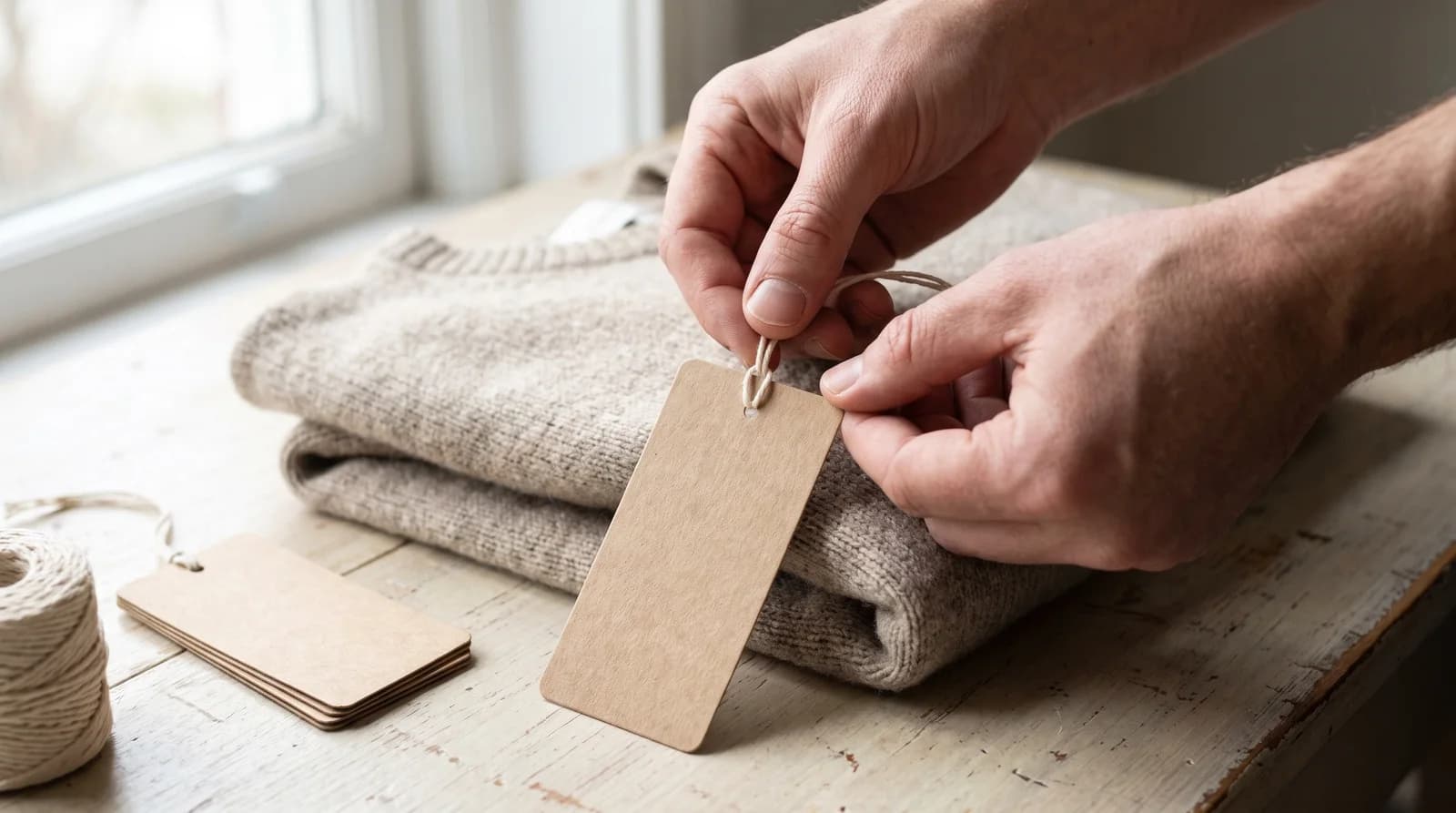
Design hang tags at actual size, from the printer’s template with its bleed and safe margins. Pick a card stock whose color and texture fit your brand: coated white, uncoated, kraft or recycled. Finishes such as foil, embossing, rounded corners or a metal eyelet add cost and time.
Attach with string and a safety pin, a plastic tag fastener through a seam or the label, or a ribbon. Keep fasteners out of delicate fabric, where the hole shows.
What drives the cost, and how to get quotes
Label prices depend on type, size, colors, fold, finish, quantity and turnaround. Many makers set a minimum per design. Send every maker the same request:
- Label type, size, fold, finish and colors, with your artwork as a vector file.
- Quantity per design and per size, and a price at two or three quantities.
- A digital proof, and a physical sample for a woven label.
- Turnaround time and shipping to your factory or to you.
Ask your manufacturer too: a full package factory may source labels, while a cut, make and trim factory usually expects you to supply them (see finding a clothing manufacturer).
How to make clothing tags for a tiny run
- Iron-on or sew-on printed labels, printed at home on fabric sheets or ordered in small sets. Sew the corners if heat alone does not hold after washing.
- Stamped cotton tape: a custom rubber stamp and permanent fabric ink, heat-set as the ink maker says.
- Home-printed hang tags: card stock, a paper trimmer, a hole punch and cotton string.
Handmade labels follow the same law, so wash and dry a labeled test piece several times before you sell.
Where do labels go, and how are they attached?
The short answer
On a garment with a neck, the country of origin goes on the front of a label at the inside center of the neck. Fiber, business name and care can share that label or sit on another easy-to-find one, such as a side seam. On skirts and trousers, the inside of the waistband works.
| Garment | Origin label | Fiber, business name, care |
|---|---|---|
| T-shirts, hoodies, dresses, jackets | Front of a label at the inside center of the neck, midway between the shoulder seams or next to another neck label | Same label (front or back), or another easy-to-find label such as one in a side seam |
| Skirts, trousers, shorts | A conspicuous label, such as inside the waistband | Inside the waistband; the FTC says inside a pocket or a pant leg is not conspicuous |
| Suits and sets sold as a unit | The FTC says only one piece of a set needs labeling if every piece has the same fiber content | One care label on the major piece if every piece has the same care; each piece gets its own if care differs or pieces are sold separately |
| Hats | Not covered by the Textile Act or the care rule | Wool hats still need a wool label under the Wool Act |
The FTC says the country of origin label should not be covered or obscured by any other label, and a label inside the elbow is too hidden for fiber and business details. The care label must be easy to find at the point of sale; if packaging hides it, repeat the care information on the package or a hang tag.
Factories sew labels during production, so put each label’s content, size and position in your tech pack and approve them on the sample. With print-on-demand clothing, ask your supplier what label its blanks carry and whether yours can replace it.
Why show your labels in product photos?
The short answer
A sharp close-up of your label shows a buyer the piece is finished and yours, and answers fabric and care questions before anyone asks. Add label detail shots of the real garment to each product, next to your on-model and flat photos.
- The neck label, straight on, in daylight, close enough to read the logo.
- The care and content label, flat and in focus, so every word is readable.
- Any printed neck or waistband label, if the piece has one.
The clothing product photography guide has the full shot list.
On-model photos once your stock is labeled
On-model shots will not show the label, so the close-up is yours to take. For the rest, Tryly’s AI clothing photography puts a flat, hanger or ghost-mannequin photo of each piece on one of 500+ models, or your own model or yourself.
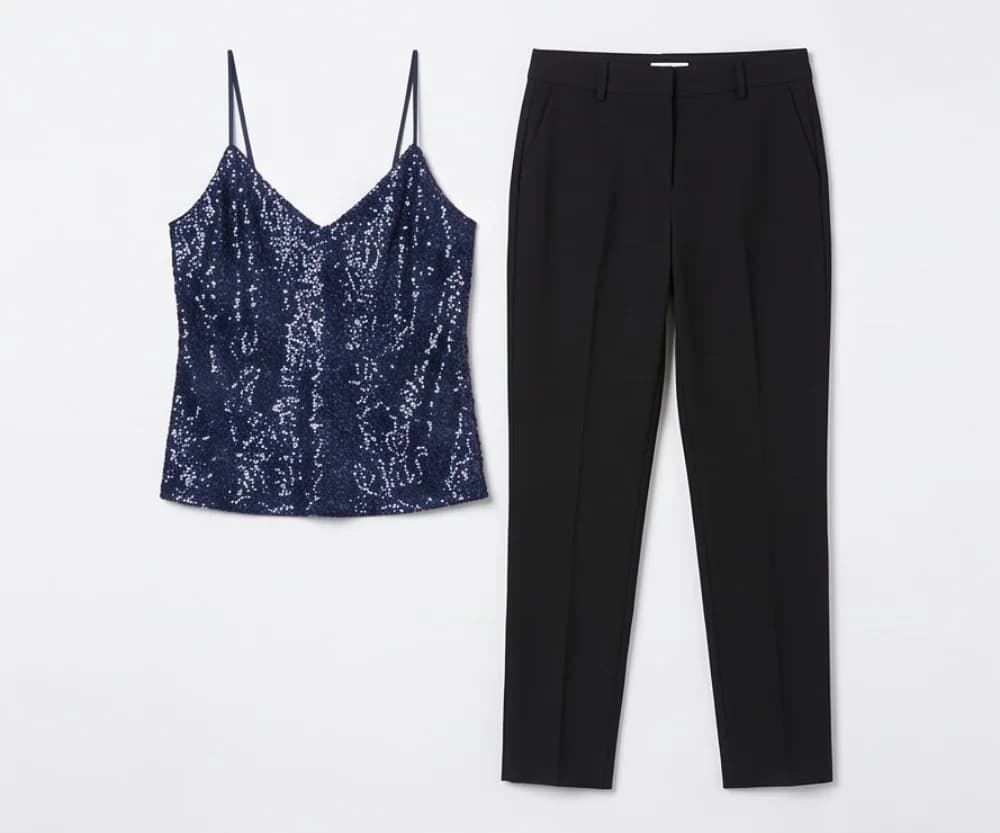
01 Flat photo
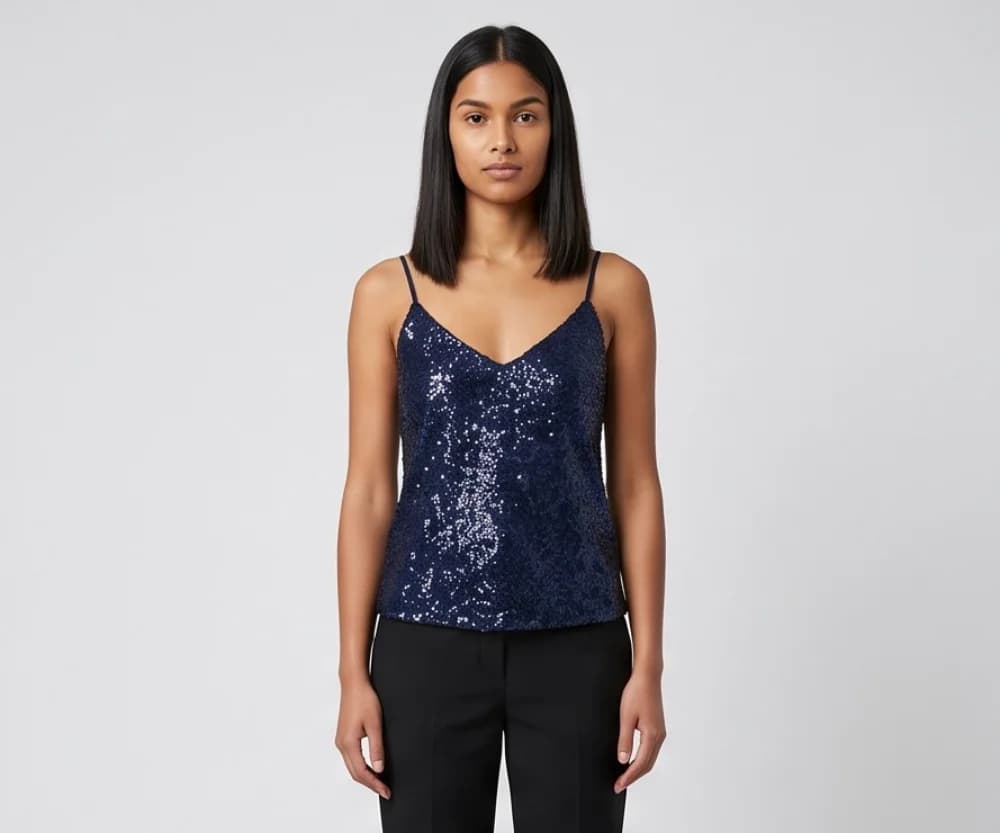
02 On a model
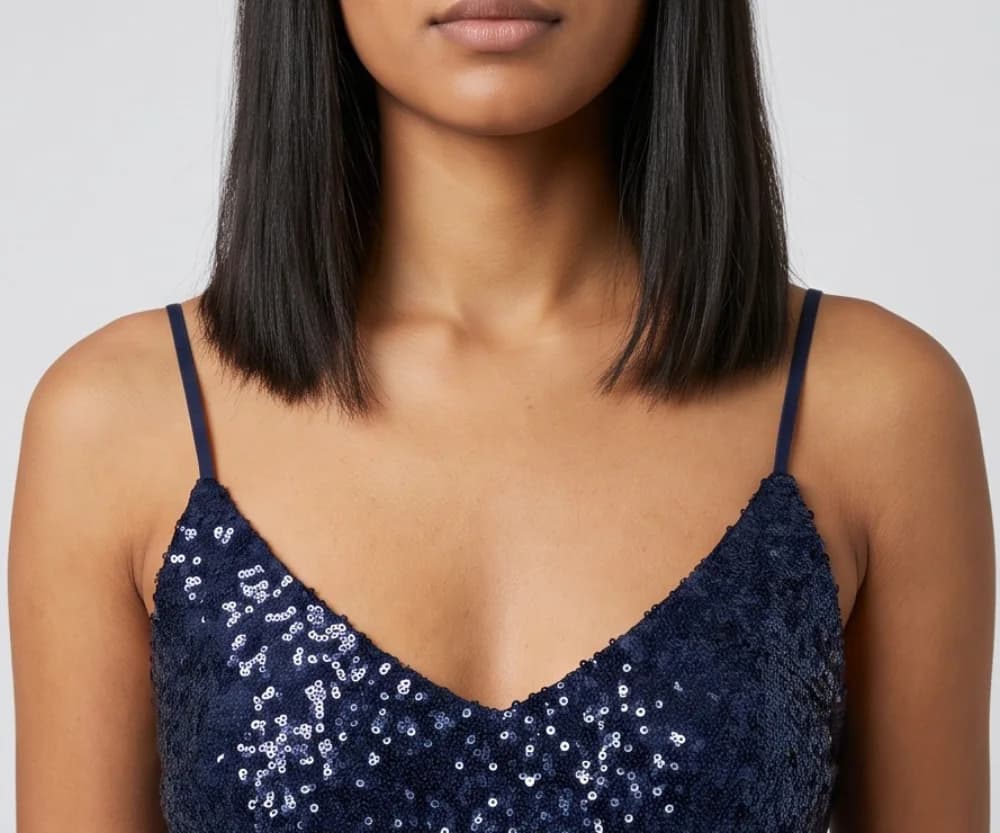
03 Detail
Keep one model across the collection; the collection demo shows ten garments on one model. For a clean grid, ghost mannequin photos start from the same flat photos. One photo is one credit: a 10-piece drop at four photos each is 40 photos, $10 at Tryly’s lowest rate.
Photos made on a paid plan can be used on your store, in ads and on social media. Some marketplaces require listing photos you took yourself, so check each platform’s photo policy first.
Checklist before you order labels and hang tags
The short answer
Before you pay for a label run, check the wording against the FTC rules, the placement against the garment, and every label against the tech pack and the approved sample.
- Fiber content written in generic names and percentages, checked against the fabric supplier’s specification.
- Your full business name or RN on the label, not only your brand logo.
- Care instructions wash-tested on a real sample, including trims, linings and prints.
- Country of origin names one country and sits on the front of the neck label, not covered by another label.
- Hang tag fiber claims checked, with a “see label” line if the tag names one fiber of several.
- Barcodes or SKUs assigned per size and color before tags are printed.
- Children’s pieces carry a permanent tracking label.
- Label content, size and position added to the tech pack and approved on the sample.
- Product pages say “made in U.S.A.”, “imported” or both, matching the label.
Questions about clothing labels and hang tags
What information is legally required on a clothing label in the US?+
Fiber content, country of origin, and the business name or RN of the maker, importer or another business marketing or handling the garment, under the FTC’s Textile and Wool Acts rules. The FTC’s Care Labeling Rule adds care instructions that stay attached and readable for the life of the garment. Children’s products also need a permanent CPSC tracking label.
Are hang tags required by law?+
No. The FTC rules require the sewn-in or printed labels, not a hang tag. A hang tag can repeat care information when packaging hides the label, and anything it says about fiber must be true; if it names one fiber of several, it must tell buyers to see the label for the full fiber content.
Do I need an RN number to sell clothing?+
No. The FTC says you may put your company business name on the label instead of an RN, and an RN is not required to do business in the US. If you want one, it is free, it is issued only to US businesses, and the FTC usually processes online applications within 3 business days or sooner.
Can I put my brand name on the label instead of my company name?+
Only if the brand is the name your company does business under, the one on your invoices. Otherwise the required label needs your full business name or your RN. Your logo can still go on the main woven label.
Can care instructions go on a hang tag instead of a sewn-in label?+
For most clothing, no. The Care Labeling Rule says care labels must be attached permanently and stay legible during the useful life of the product, and a hang tag comes off after purchase. A few exceptions exist: for example, totally reversible clothing without pockets needs only a temporary label at the point of sale, and hosiery can carry care instructions on a hang tag.
Sources: FTC, Textile and Wool Acts labeling; FTC, Care Labeling Rule; FTC, RN questions; CPSC, tracking labels; GS1 US, barcodes; Your Europe, textile label; Competition Bureau Canada, textile labelling.
Written by
Elena Varga
Head of Content, Tryly Academy
Former e-commerce photo producer who ran catalogue shoots for fashion labels for over a decade. Writes the Academy’s guides.
- 11 years in fashion e-commerce
- 1,200+ catalogue shoots produced
Expert review
Sofia Moretti
Fashion photographer · Expert reviewer
Has shot campaigns and on-model e-commerce for fashion brands for 14 years. Reviews every Academy article for accuracy.
- 14 years in fashion photography
- Campaign and catalogue work across Europe
How we work: every Academy article is written by a specialist, reviewed by a working fashion photographer, and re-checked against its sources when prices or rules change.