Guide
How to start an online boutique: a step-by-step plan
How to start an online boutique, for the shop owner who curates rather than designs: the resale certificate, wholesale sourcing, pricing, where to sell, the first buy, photos of your real stock and the launch.

 By Elena Varga
 · Reviewed by Sofia Moretti |Fact-checked|14 min read
Key takeaways
- 1A boutique buys finished pieces at wholesale and sells its edit; a brand designs and makes them. The boutique needs a resale certificate, a first buy and a photo method more than it needs production samples.
- 2Keystone (twice the wholesale cost) is where pricing starts. What you keep is what is left after processing, platform fees, shipping and returns.
- 3The supplier’s photos are in every shop that bought the piece. Your own photos of your real stock, on one model across the whole shop, are what make it yours: 40 pieces at two photos each is 80 photos, $20 at Tryly’s lowest rate.
10 free photos, no card. Photos as low as $0.25 each.
On this page+
How do you start an online boutique?
The short answer
To start an online boutique, pick one customer, register the business and get a resale certificate, open retailer accounts with wholesale brands, price from keystone and check the margin, set up your own store, make a small first buy in full size runs, photograph the stock on one model, write listings with measurements and fabric, launch on a date to a waitlist, then ship, take returns and reorder what sells.
Ten steps, in the order the money goes out. Whether you start a boutique from a spare room or alongside a job, the customer decides what you buy, and what you buy decides everything after it.
Boutique or brand: which one are you starting?
The short answer
A boutique curates: it buys finished pieces from other brands at wholesale and sells its selection. A brand designs: it makes its own pieces, with samples, a factory and a production run. This guide is for the boutique. If you want your own label, the clothing brand launch plan is the route.
| You are starting | What you do | Money up front | Time to first sale | What you control |
|---|---|---|---|---|
| Online boutique | Choose and buy finished pieces from brands at wholesale | A first stock buy, or pre-orders | Weeks: order, receive, photograph, list | The edit, the prices, the photos and the service |
| Clothing brand | Design pieces and have them made | Samples plus a production run | Months: design, sample, produce | Everything, including fit, fabric and labels |
Shopify’s online boutique guide describes the boutique model as buying other brands’ finished products at wholesale prices. You are faster to market and need no production samples, but every other boutique can buy the same piece, so the edit, the photos and the service are what make the shop yours.
Step 1: Who is your online boutique for?
The short answer
For one shopper you can describe in a sentence: who she is, what she buys clothes for, and why she would buy from your edit rather than from a department store or the brand’s own site.
- Write the sentence: [kind of pieces] for [customer] who [need]. Linen workwear for women over forty who want pockets, say, or petite occasion dresses under a price you set.
- Find where she shops now, and read the reviews. Complaints about fit, fabric and photos that do not match are the gaps a boutique fills.
- Pick one price band. A $30 top next to a $300 coat confuses the shopper and the ads.
Step 2: How do you register a boutique and get a resale certificate?
The short answer
In the US, most small boutiques register a business name with state and local governments, get the licenses their state and city require, register for sales tax and get a resale certificate so wholesalers can sell to them without charging sales tax. The details differ by state and city: check with your local authority and an accountant. None of this is legal advice.
Registering the business
The SBA’s registration guide and its licenses and permits page explain the state and local steps. On the federal side, the IRS’s starting-a-business page covers the EIN, which the SBA notes is free, and sends you to your state’s website for the rest.
Sales tax and the resale certificate
Shopify’s boutique guide says you may need a seller’s permit (or seller’s license) to sell your products online. The resale certificate is the other half: when you buy stock to resell, you give the wholesaler an exemption certificate instead of paying sales tax on the purchase. The Streamlined Sales Tax Governing Board says to give the completed certificate to your supplier and keep a copy, and that not every state allows every exemption, so check with each state.
Step 3: Where do you buy wholesale clothing for a boutique?
The short answer
From online wholesale marketplaces, from brands directly, and at trade shows and regional apparel markets. Marketplaces are the easiest start: register as a retailer with your seller’s permit, browse many brands at wholesale prices and order from each brand separately, often in small quantities.
| Route | How it works | Watch for |
|---|---|---|
| Online wholesale marketplaces | Register as a retailer, browse many brands at wholesale prices, order from each brand separately. | Each brand sets its own minimum. Other boutiques see the same catalog. |
| Direct from a brand | Ask for the line sheet and wholesale terms, and order for the season. | Minimums per style or size run, lead times, and any exclusivity the brand asks for. |
| Trade shows and regional apparel markets | See and touch the pieces, meet the reps, place orders for delivery months later. | Buyer registration usually asks for business documents. Money is committed long before stock arrives. |
| Local makers and small labels | Small wholesale orders or consignment, with pieces nobody else stocks. | Restocks can be slow or impossible, so sell each piece as its own story. |
Two wholesale marketplaces, from their own pages
Faire says it is free to join for retailers and brands, that over 100,000 brands sell on it, that eligible retailers can use 60-day payment terms, and that a first order from a new brand can be returned free within 60 days. FashionGo is an apparel-first wholesale marketplace: a retailer account asks for a copy of your seller’s permit, verified in one to two business days, and its page lists free shipping on orders from $300 from apparel vendors ($100 from accessories and jewelry vendors) and pay-later terms of 30, 45 or 60 days. Terms change; read each platform’s current page.
Minimums, pre-orders and the sample
Brands set minimums as a dollar opening order, a minimum per style, or size packs that bundle a run of sizes. Some take pre-orders for a coming season with delivery months later, so the money is committed before you have seen the style sell. Order a sample first and check three things on the table: the fabric against the photo, the sizing against the brand’s chart, and the labels.
Step 4: How do you price boutique clothing?
The short answer
Start from keystone: the retail price is twice what you paid the wholesaler. Then check what is left after payment processing, the platform’s fee, the shipping you absorb and the returns you take back, and check it against what other shops charge for the same piece.
Keystone, and what it leaves out
Shopify’s keystone pricing guide defines it as a retail price of two times the wholesale cost, a 100% markup and a gross margin of about 50%: a top that costs you $20 is priced at $40 and leaves $20 before anything else. The same guide lists what keystone ignores: shipping, overhead, duties and fees, competitor pricing, and what shoppers are willing to pay.
What comes out of that $20
- Per order: card processing, a marketplace’s fee if you sell there, the shipping you offer free, packaging, and an allowance for returns.
- Per month or season, spread over the pieces you expect to sell: the store subscription, photos, ads and the markdown on what did not sell.
If the math only works at a price your customer will not pay, change the piece before you order. Search the style name too: if the same wholesale piece is everywhere at keystone, you will not win on price.
Step 5: Should a boutique sell on its own store or a marketplace?
The short answer
Your own store holds your brand, your prices and your customer list, and you bring every visitor. A marketplace brings shoppers but sets the rules: Etsy, for one, does not allow reselling new clothes at all, while Poshmark has a Boutique tag for wholesale stock. Start with your own store and the social accounts that feed it.
Your own store: the core of an online boutique business
On a platform such as Shopify, the Help Center’s store checklist runs through the setup: business name, address, shipping, taxes, payment providers and domain. It tells you to test successful and failed transactions before launch and states that tax compliance is your responsibility: Shopify calculates taxes but does not file or remit them unless you use its automated filing. Plan prices and card rates are on its pricing page.
Marketplaces
Etsy’s help center says reselling, which it defines as selling a commercially available item the seller did not make or design, is not allowed, except for handpicked vintage over 20 years old, craft and party supplies, and gift baskets. A boutique of new wholesale pieces does not belong there; a rail of true vintage might. Poshmark has a dedicated tag for this: its Boutique tag is for items bought wholesale or directly from a distributor and sold to the public for the first time, and one multi-item listing can hold several quantities and sizes of the same piece. The guide to selling on Poshmark covers its fees and photo rules, and where to sell clothes online compares the rest.
Step 6: How much stock should a new boutique buy?
The short answer
Small and deep, not wide and shallow: a few styles in a full size run, sold together as a drop, then reordered by size and color as they sell. Shopify’s boutique guide puts that first inventory buy at typically $1,000 to $7,000, the largest startup expense.
- Buy full size runs. A style with only a medium left looks sold out, not exclusive.
- Buy a story, not a list. Pieces that go together can be photographed as outfits, posted as one drop and sold as a set. Odd pieces sit.
- Use pre-orders carefully, and track sell-through. Pre-orders, where a brand takes them, let you test a style before you pay for it, but the customer waits, so state the delivery window. Reorder by style, size and color before a winner sells out.
Step 7: How do you get product photos that are not the supplier’s?
The short answer
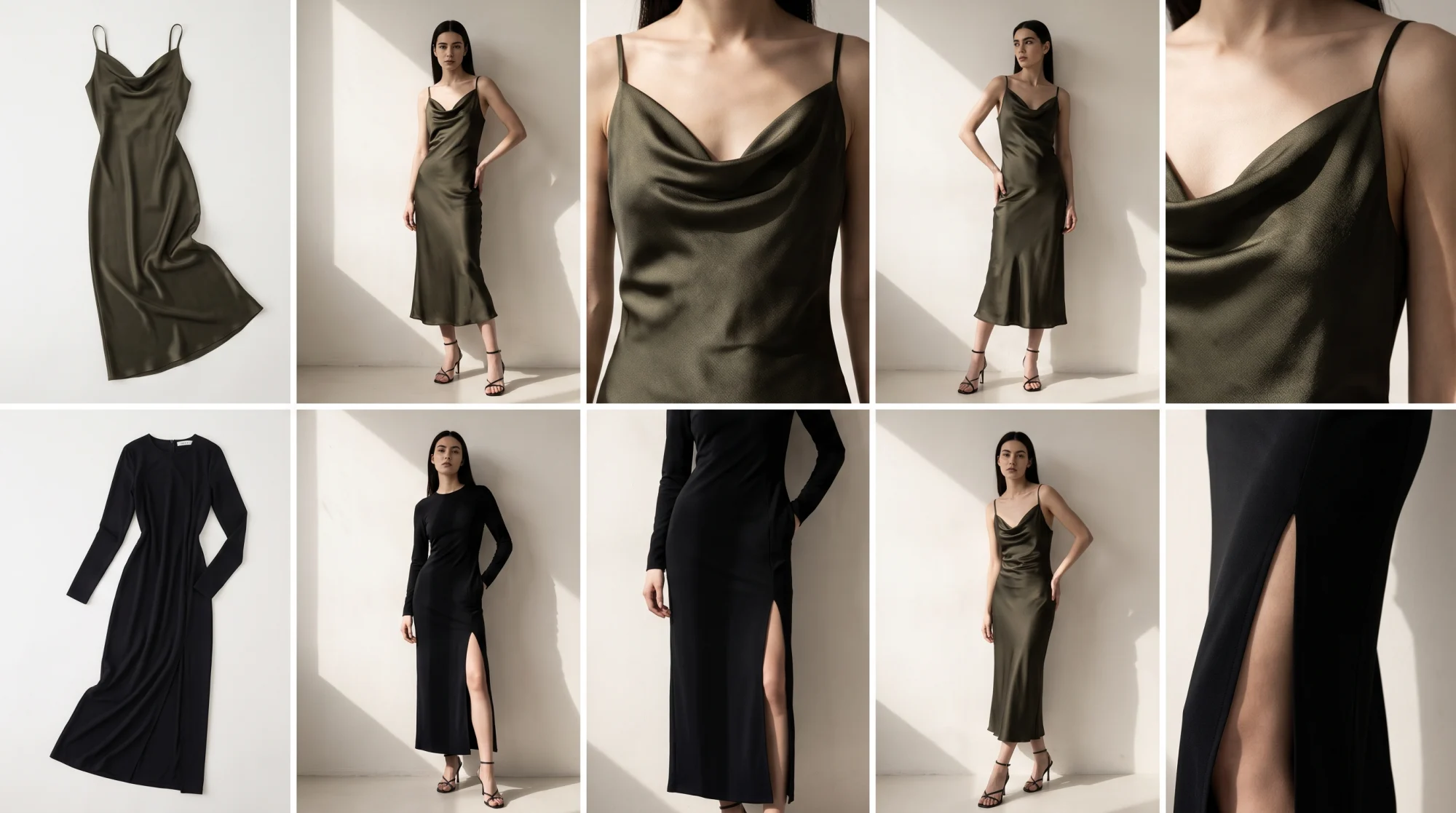
Every shop that buys the same wholesale piece gets the same supplier photo. Take your own photos of the stock you hold, then make on-model photos of that real stock with Tryly for your own store, on one model across every listing. One photo is one credit, and you start with 10 free photos, no card.
The boutique photo problem
Each brand’s photo has its own model, light and crop, so a shop that stocks six brands looks like six shops. And it can be wrong for your stock: a color that shifted between sample and delivery, a different length.
Shoot your own
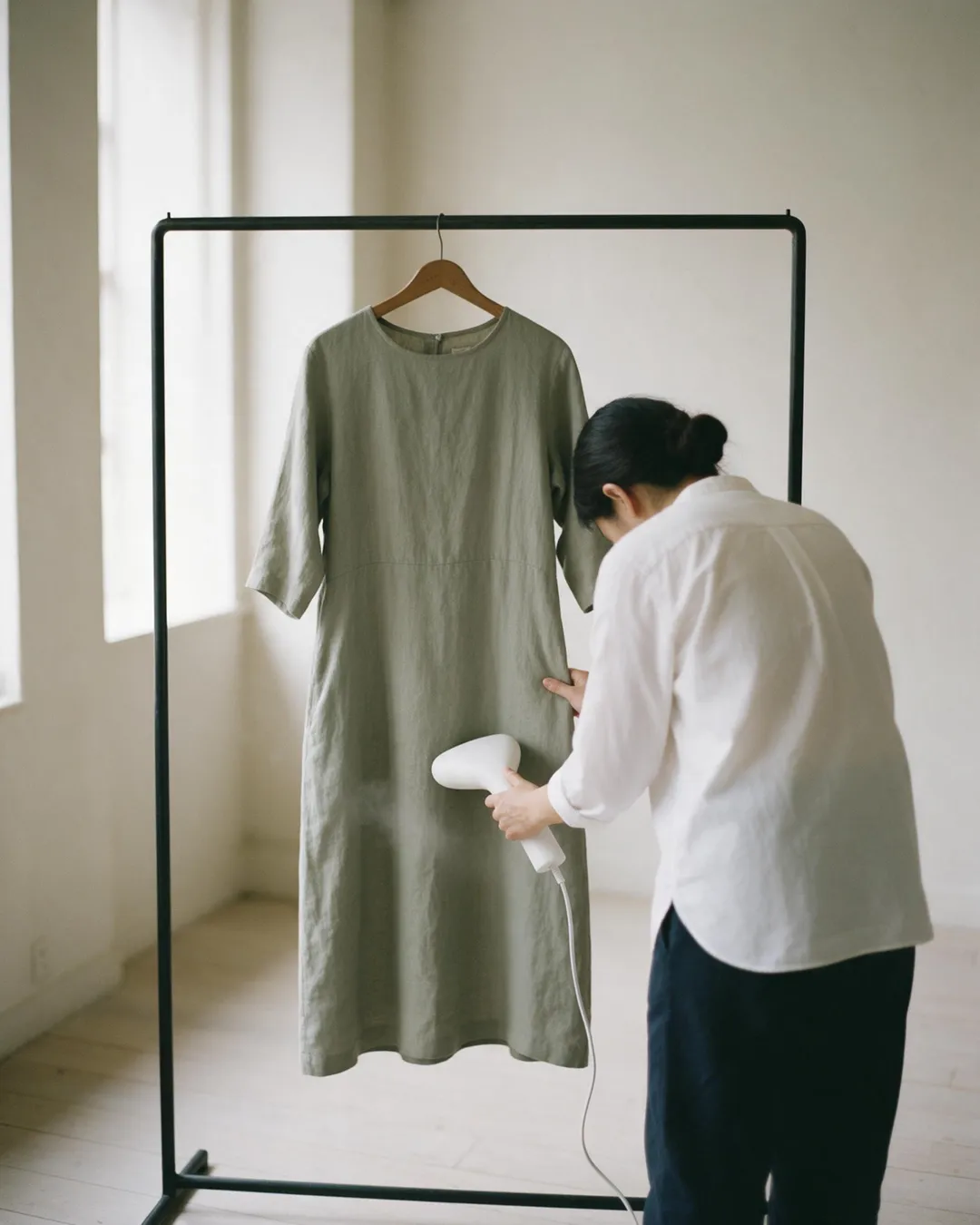
A phone, a window and a plain background are enough for the flat and hanger photos, which show the true color; the method is in how to photograph clothes to sell. What a phone cannot easily give you is one model on every piece from every brand.
On-model photos of your real stock, on one model
With Tryly’s AI clothing photography, you upload the flat, hanger or ghost-mannequin photo of each piece and pick one model from 500+, or your own model or yourself. You choose the poses and a studio or editorial background, and the photo lands in your gallery in about 15 seconds. A 2K photo is one credit.
 Before
 After
AfterThe part that matters for a boutique is the model: pick one and use her for every piece from every brand. On a paid plan a “Same model” button brings back the model from your last shoot in a click, and the collection demo shows ten garments on one model, then on a second model, with no new shoot. At Tryly’s lowest rate of $0.25 per photo, 40 pieces at two photos each, front and back, is 80 photos: $20.
The test that matters
Try it on your hardest garment first.
Sellers judge an AI photo tool on the piece most likely to go wrong: a print, a logo, sheer fabric or a detail that has to sit exactly right. Check the result at full size before you publish it. Here: a navy sequin camisole with thin straps, worn with black tailored trousers.
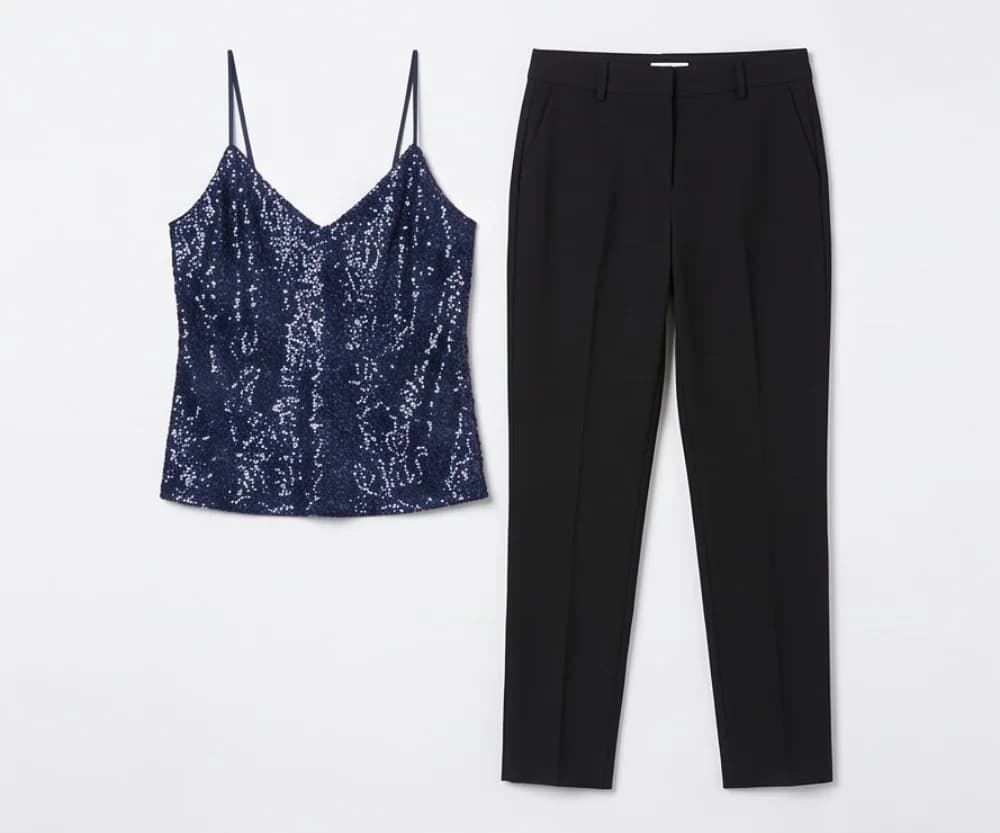
01 Product photo
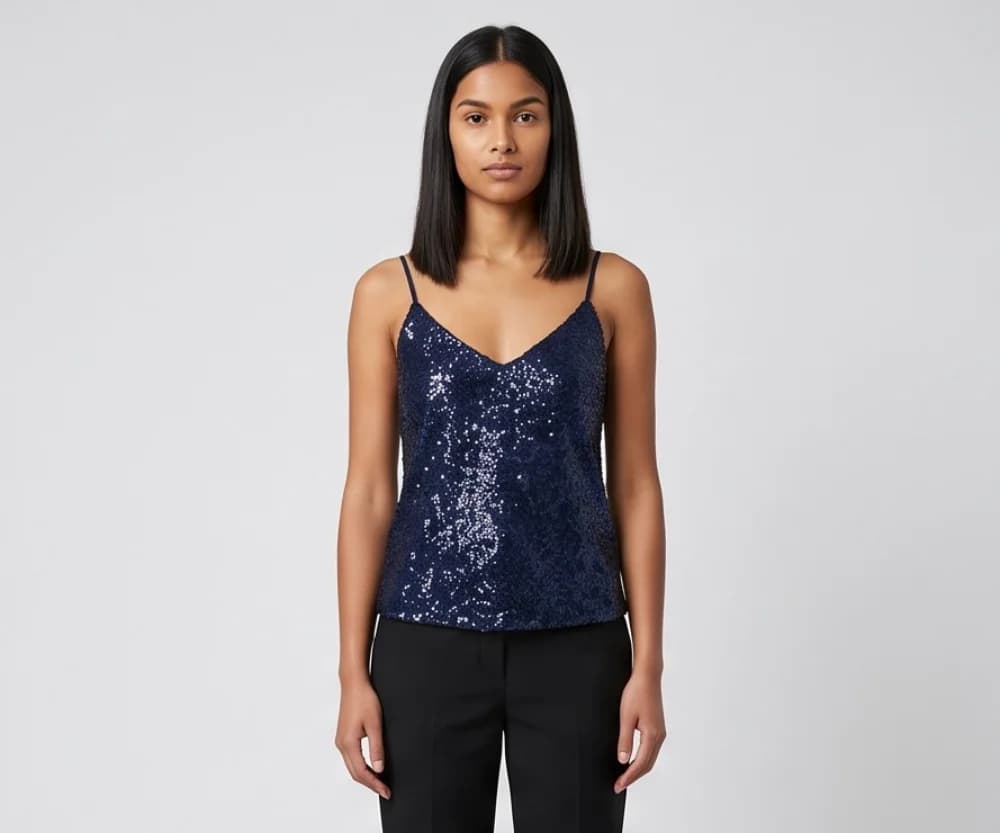
02 On the model
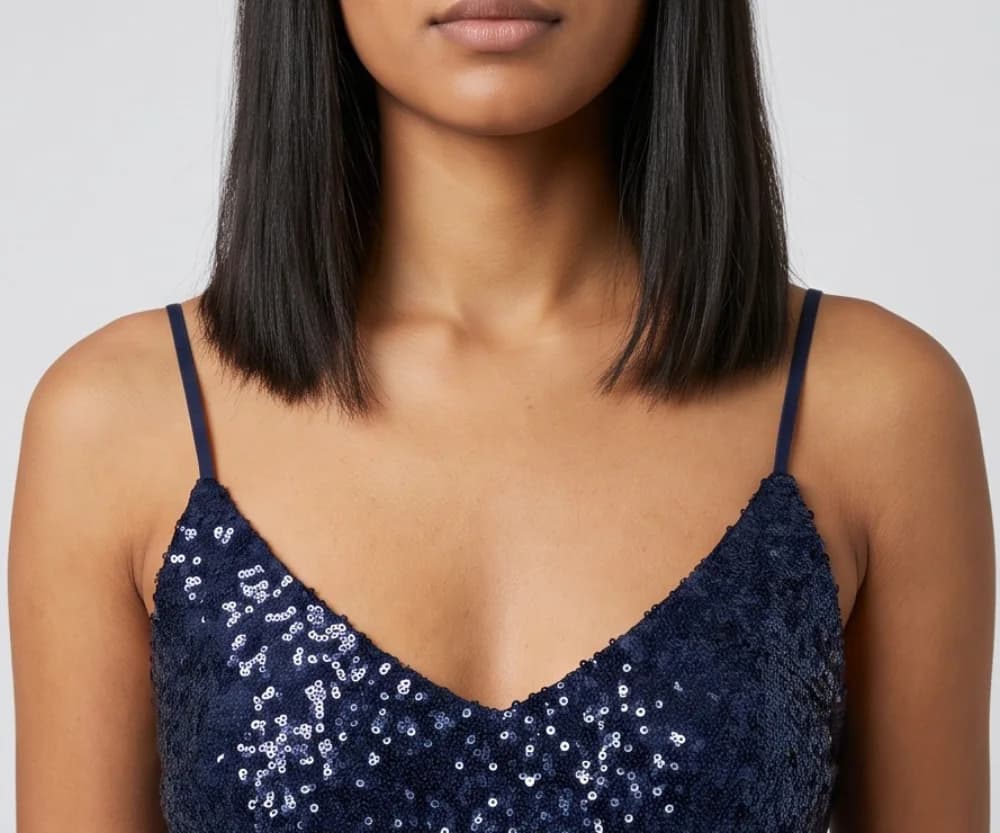
03 Full-size check
10 free photos, no card.
Photos made on a paid plan can be used on your store, in ads and on social media, and shoes, bags, hats, watches and jewelry go on models the same way. Plans start from $9.99/month (Starter plan, billed annually), from $0.33 a day.
Step 8: What goes in a boutique product listing?
The short answer
What the supplier’s page does not have: measurements and a fit note from your own piece, the fiber and care from its labels, a size chart for that brand, your own photos, and why you chose it.
| Listing field | What to put there |
|---|---|
| Measurements, taken flat | Pit to pit, length, waist, hip, inseam, from the piece on your table, not the supplier’s chart. |
| Fiber content and care | Copied from the sewn-in labels. US law requires fiber content on the label and care instructions attached to the garment. |
| A fit note | Runs small, runs large or true to size, and how it fits your model, with her size stated. |
| A size chart for that brand | Wholesale brands size differently. One chart per brand, not one for the shop. |
| Your own photos | Front, back and a detail on your model, plus the flat photo. Same model, background and crop on every listing. |
| The story | Why you chose it and what to wear it with. That is what a boutique sells that a warehouse does not. |
Image sizes differ by platform and ad channel; the product image size requirements guide has each platform’s numbers.
Step 9: How do you launch and market an online boutique?
The short answer
Open only when the shop is finished, even if that means a smaller drop: every supplier photo replaced and every listing measured. Gather interested shoppers’ emails in the weeks before, then announce the drop where your customer already spends her time, with the same model and look in every post.
- A resale certificate on file with every wholesaler you order from.
- Every supplier photo replaced with your own: the piece flat, on your model, and a close-up.
- Each brand’s own size chart attached to its pieces, and a fit note on every listing.
- Every sample checked against its listing: color, length and the sewn-in labels.
- A reorder point set for each style and size, so you reorder a winner before it sells out.
- The drop email and launch-day posts scheduled, built from the listing photos.
If your customer is on Instagram, the guide to Instagram for clothing brands covers the account and the shop link. A short lookbook of the drop, styled as outfits, gives you the launch posts, the first email and the ad images in one set. Send the drop to your email list before you post it.
Step 10: How do you handle shipping, returns and customer service?
The short answer
Write the shipping and returns policy before the first order, ship on a fixed schedule, answer messages the same day, and treat every return reason as a fix for a listing.
- Shipping: state the handling time on the product page, ship on set days, and send tracking the day it ships.
- Returns: one clear window, one clear condition, easy exchanges. Clothing is tried on at home, so returns are part of the model, not a failure of it.
- Read the reasons. “Too small” means a fit note and a back photo. “Not as pictured” means checking your photo’s color against the piece.
- Keep the labels on. The FTC’s textile labeling guide says it is illegal for retailers to remove labels with required information (fiber content, country of origin, company name or RN) without replacing them, and its care labeling rule covers the care instructions.
Questions about starting an online boutique
How much does it cost to start an online boutique?+
Shopify’s online boutique guide puts typical startup costs at $2,000 to $15,000, with inventory, which it calls the largest initial expense, typically $1,000 to $7,000; check its page, since figures change. That range also covers the store plan, registration, branding, launch marketing, shipping supplies and photos; at Tryly’s lowest rate of $0.25 per photo, 40 pieces at two photos each is $20.
Do I need a business license or a resale certificate to open a boutique?+
Usually some registration, and it varies by state and city: the U.S. Small Business Administration says most small businesses register their business name with state and local governments and need licenses and permits that vary by activity and location. Wholesalers ask for a seller’s permit or resale certificate before they open a retailer account; FashionGo, for example, asks for a copy of your seller’s permit. Check with your local authority and an accountant.
Can I start an online boutique with no inventory?+
You can start small rather than with nothing: a few styles in a full size run, or pre-orders where a brand takes them. Dropshipping exists, but you never see the piece, so you cannot measure it, check its labels or photograph it, which is most of what makes a boutique worth buying from.
Can I sell boutique clothing on Etsy?+
No: Etsy allows reselling only for handpicked vintage over 20 years old, craft and party supplies, and gift baskets; sell new wholesale pieces on your own store.
Where do online boutiques buy their clothes?+
From online wholesale marketplaces such as Faire and FashionGo, where you register as a retailer and order from many brands at wholesale prices; directly from brands, using their line sheets; and at trade shows and regional apparel markets, where orders are placed for delivery months later. Order a sample before a first buy.
How do I price items in my boutique?+
Start from keystone, which Shopify’s guide defines as twice the wholesale cost, a gross margin of about 50%, then check what is left after processing, platform fees, shipping and returns, and what other shops charge.
How do I get model photos of my stock without a photoshoot?+
Photograph each piece flat, on a hanger or on a mannequin, then put it on one model with Tryly (one of 500+, your own model or yourself) for every piece in the shop. Photos cost as low as $0.25 each, and you start with 10 free photos, no card.
Sources: Shopify’s online boutique guide; Shopify’s keystone pricing guide; Shopify Help Center, store checklist; Shopify pricing; Etsy Help, drop shipping and reselling; Poshmark, what Boutique means; Poshmark Blog, multi-item listings; Faire, how it works; FashionGo; SBA, register your business; SBA, licenses and permits; SBA, tax ID numbers; IRS, starting a business; Streamlined Sales Tax Governing Board, exemptions; FTC, textile labeling; FTC, care labeling rule; on-model guidance from Google Merchant Center Help, linked in the box above.
Written by
Elena Varga
Head of Content, Tryly Academy
Former e-commerce photo producer who ran catalogue shoots for fashion labels for over a decade. Writes the Academy’s guides.
- 11 years in fashion e-commerce
- 1,200+ catalogue shoots produced
Expert review
Sofia Moretti
Fashion photographer · Expert reviewer
Has shot campaigns and on-model e-commerce for fashion brands for 14 years. Reviews every Academy article for accuracy.
- 14 years in fashion photography
- Campaign and catalogue work across Europe
How we work: every Academy article is written by a specialist, reviewed by a working fashion photographer, and re-checked against its sources when prices or rules change.