Guide
Print-on-demand clothing: how to start, what to sell and how to show it
For designers with a folder of artwork and no stock: how print on demand works, which print on demand shirts, hoodies and sweatshirts to start with, the print methods in plain words, how to pick a provider, the margin math, where to sell, samples, and product photos for clothes you never hold.

 By Elena Varga
 · Reviewed by Sofia Moretti |Fact-checked|15 min read
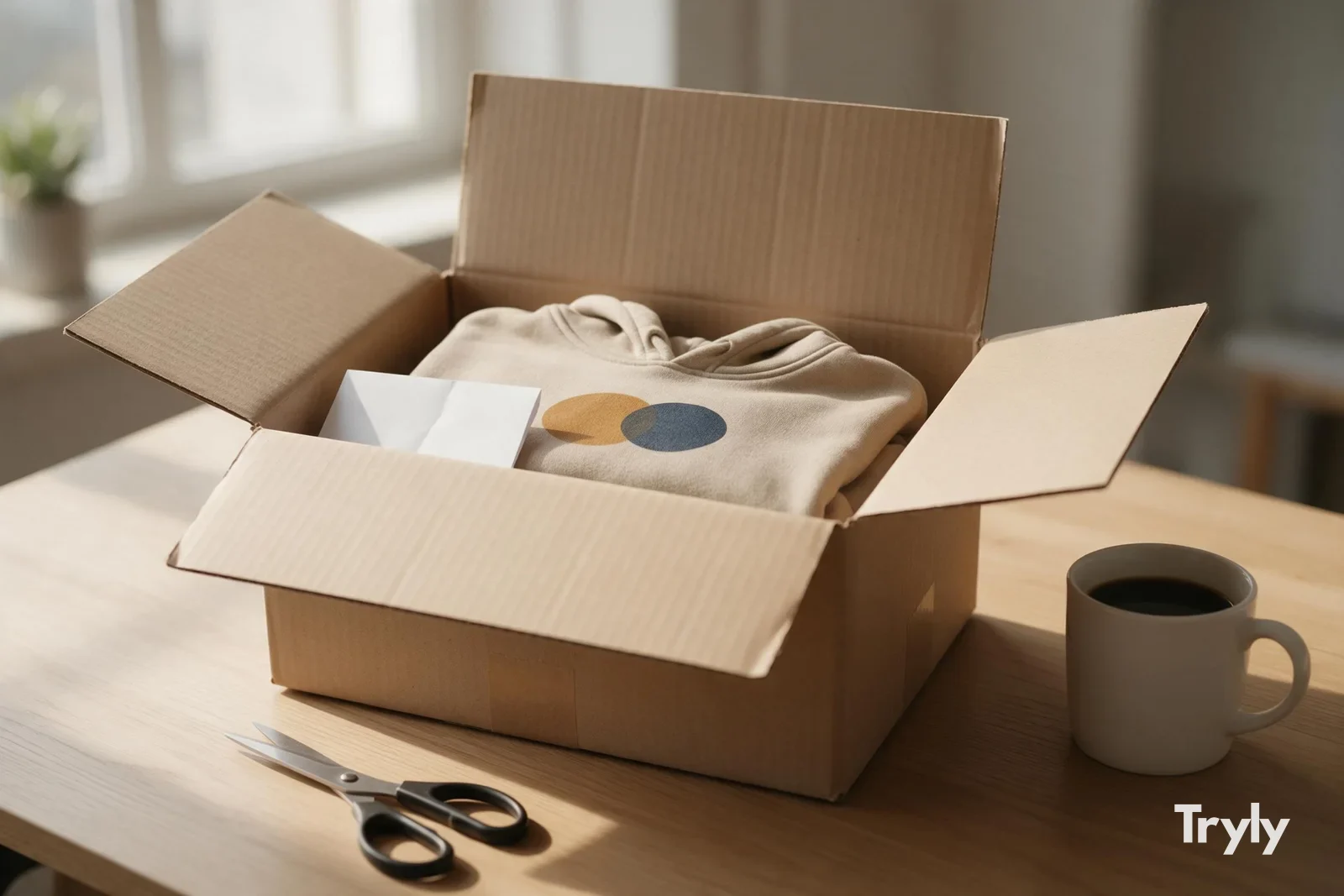
Key takeaways
- 1You design and list; a provider prints and ships each order after it sells. No stock, no minimums, and you pay the base cost per order, so the money is made or lost on designs, price and photos.
- 2Order one sample of every blank before you list it, with your hardest design on it. It is your fit check, your print check, your size chart and your photo sample.
- 3The provider mockup lists a product; a photo of the real sample sells it. Made with Tryly from a flat photo of the sample, every design can sit on the same model: 40 photos are $10 at Tryly’s lowest rate.
10 free photos, no card. Photos as low as $0.25 each.
On this page+
How does print on demand clothing work?
The short answer
Print on demand clothing works like this: you upload a design, list it on a blank you chose (a tee, a hoodie, a sweatshirt), and when a customer orders, a provider prints that one item and ships it to them. You pay the provider’s base cost per order, after the sale. No stock, no minimums, no printer. Your job is the designs, the listings, the photos and the marketing.
Printful’s print-on-demand page lists no order minimums and says you pay only when a customer orders; Printify’s print-on-demand page describes products shipped only after a sale, with no upfront investment.
Because anyone can start for free, a print on demand clothing brand stands out only through its niche, designs, price and product pages. Still choosing between print on demand, blanks and small-batch? Start with starting a clothing brand.
What print on demand apparel should you sell first?
The short answer
Pick two or three of the blanks that sell everywhere: a unisex tee (print on demand shirts), a hoodie, a crewneck sweatshirt or, if your niche wears them, a cap. In a few colors, with your designs across all of them, that is a first catalog. Every extra blank is another sample and another photo set before your first sale.
| Product | Why it sells | Watch for |
|---|---|---|
| T-shirt | The entry product, with the lowest base cost. | Blank weight and fit vary. A thin blank makes a good design feel cheap. |
| Hoodie | The highest price and the most room per unit. | Higher base cost and heavier shipping. Fleece-faced fabrics cannot take DTG. |
| Crewneck sweatshirt | Between the tee and the hoodie on price. | Same checks as the hoodie. |
| Cap | A low-cost add-on that carries a logo well and ships small. | Usually embroidered (some providers also offer DTF). Tiny embroidered letters may be unreadable, and each new design carries a digitization fee. |
| All-over print piece | Edge-to-edge patterns a chest print cannot give. | Polyester, cut and sewn after printing; the white base can show at seams. |
A blank is the unprinted garment the provider prints on. Its brand, fabric and weight decide how the piece feels, fits and takes the print, and what buyers will pay. Printful’s DTG page says 100% cotton works best for DTG and that sherpa, brushed fleece and terry cloth cannot be used for it, so the blank and the print method are one decision.
DTG, DTF, embroidery or all-over print: which print method for which product?
The short answer
DTG for detailed designs on cotton, DTF for bright designs on any fabric color, embroidery for logos and caps, all-over print for edge-to-edge patterns on polyester. The provider’s catalog shows which methods each blank offers, so decide the method before you finish the artwork.
In plain words, from Printful’s DTG, embroidery and all-over print pages, its printing disclaimers, and Printify’s decoration methods guide:
| Method | How it works | Best for | Watch for |
|---|---|---|---|
| DTG (direct to garment) | Water-based ink applied straight onto the garment and absorbed by the fibers. | Detailed, multi-color designs on cotton tees, hoodies and sweatshirts. | Needs at least 50% cotton; blends print faded. No white ink on white garments. |
| DTF (direct to film) | Printed onto a film on a white ink layer, then transferred to the fabric with adhesive powder and heat. | Bright designs on any fabric color, including blends, activewear and caps. | A stiffer, textured feel; can crack if washed hot. Keep lines and text at least 1 pt. |
| Embroidery | Thread stitched into the fabric. | Logos, wordmarks and small designs on caps, polos, hoodies and sweatshirts. | Standard embroidery is limited to thread shades; some providers also offer unlimited-color embroidery. Elements closer than 3 mm can join. A one-time digitization fee per design. |
| All-over print | Dye heat-pressed into white polyester (sublimation), then the panels are cut and sewn. | Edge-to-edge patterns, including sleeves and seams. | Patterns cannot be perfectly aligned front to back; with dark designs the white base can show slightly at seams and folds; white cannot be printed. |
How do you choose a print on demand provider?
The short answer
Compare the seven things below for the exact blank you want, then order the same design from two providers and compare the samples in your hands.
| Criterion | What to check |
|---|---|
| Base cost | The exact blank, color and print areas (front, or front and back), plus shipping if you offer it free. Compare per product. |
| Blank quality and brands | The blank brand, fabric and weight listed for each product. |
| Print methods | Which methods the blank you want actually offers. |
| Production and shipping times | Fulfillment time plus shipping time to each country you sell to. |
| Integrations | Whether it connects to Etsy, Shopify, Amazon and the rest. |
| Sample policy | Discount, samples per month, whether a connected store is required. |
| Misprints and returns | What is covered, the reporting window, and what is not. |
You will meet Printful and Printify first; neither is a recommendation over the other. Printful’s shipping page gives 2 to 5 business days to fulfill an order, then 3 to 4 business days for standard domestic shipping in the US and Canada and 5 to 20 for standard international shipping, as an estimate. Printify’s how-it-works page describes print providers across 140+ facilities with orders routed automatically, so times depend on who prints your order. Both connect to Etsy, Shopify and Amazon.
What are the margins on print on demand tee shirts?
The short answer
What you keep on a print on demand tee is the retail price minus the provider’s base cost (blank, print and any shipping you absorb), the platform’s fees and the ad cost of the sale. The base cost is a large share of a tee’s price, so the ad line decides. Hoodies and sweatshirts leave more room.
| Line | Where the number comes from |
|---|---|
| Retail price | You set it, from what similar designs on the same blank sell for in your niche. |
| Base cost | The provider catalog: blank, color, print areas and any shipping you absorb. |
| Platform fees | The platform’s fee page: listing, transaction, processing and ad fees. |
| Ad cost per sale | Ad spend divided by the sales it produced. |
Sell a $30 tee on Etsy with free shipping and its fees policy takes a $0.20 listing fee, 6.5% of the sale ($1.95) and a payment processing fee. If the order came through an Offsite Ad, it also takes 15% ($4.50), or 12% for shops with $10,000 or more in sales over the prior 365 days. Your base cost and ad cost come out of the same $30. Once a design sells steadily, a small-batch run keeps more per piece: here is how to find a clothing manufacturer.
Where do you sell a print on demand clothing brand?
The short answer
Most print on demand clothing brands start on Etsy, their own store on a platform such as Shopify, or Amazon Merch on Demand. Etsy brings shoppers already searching and requires you to disclose your provider as a production partner. Your own store has no marketplace rules and no built-in traffic. Amazon Merch on Demand prints and ships itself and pays a royalty, after an application.
Etsy: disclose the production partner
Etsy Help lists print-on-demand services such as Printful and Printify as production partners, and you must name yours on every listing it makes. Etsy’s listing image requirements ask for “original photos of the actual product buyers will receive, not renderings or stock photos”, taken by you or by someone you asked. Stock photos are allowed in two limited cases: personalized or customized items, and items made with a production partner. Print on demand is the second case: when a production partner prints your original design onto a base item such as a t-shirt, you may use a stock photo mockup. A tee with the buyer’s own text is the first case, and its first image must show a finished, customized item, not a blank or a “Your Text Here” mockup.
Amazon Merch on Demand: apply, upload, earn a royalty
Amazon’s Merch on Demand page describes $0 inventory cost: you supply the artwork and pick the product type and colors, Amazon handles production, sales and shipping with Prime delivery, and you set the price and earn a royalty per unit, paid monthly. You apply first, and the product page is Amazon’s, not yours. Other marketplaces are compared in where to sell clothes online.
What can you print? Designs, rights and print files
The short answer
Print only what you own: your own artwork and words, fonts licensed for commercial use, and stock elements licensed for printed goods. Not other people’s trademarks, logos, characters, team names, celebrity names or famous quotes without permission. Rights holders can pursue you, and marketplaces can close shops over it. This is general guidance, not legal advice.
- Keep the licenses. Free for a website is not always licensed for products. Save the license with the design file.
- Search a phrase before you print it. Short slogans are often registered. In the US, search the USPTO’s trademark database before you print it; elsewhere, use your country’s trademark office.
- Parody, fan art and “inspired by” are not a license. If a design only works because of someone else’s name or character, it is their design.
Print files for print on demand shirts
Printful’s help center asks for at least 150 DPI, sized to the actual print dimensions, and recommends 300 DPI for all-over print designs with fine lines, small details or text. Keep essential text and graphics inside the safe print area, where small shifts cannot crop them, and export final files in sRGB as PNG or JPEG, using CMYK only to preview shifts: screen neons are mapped to the closest printable color. Check each product’s file guidelines before you upload.
Why order a sample of every blank before you list?
The short answer
Order one sample of every blank you plan to sell, in the color you will sell most, with your hardest design on it: the finest text or the thinnest lines. It shows the fabric weight, the fit, the print’s color against your screen and how it washes, and it is the piece your product photos come from.
Printful’s sample orders page gives a 20% discount to accounts with a connected store and covers a damaged, misprinted or defective sample reported within 30 days of delivery, but not being unhappy with how your own design printed. Printify’s sample ordering page says sample orders are placed at regular pricing, and to avoid designs that match the garment color so you test both the item and the print.
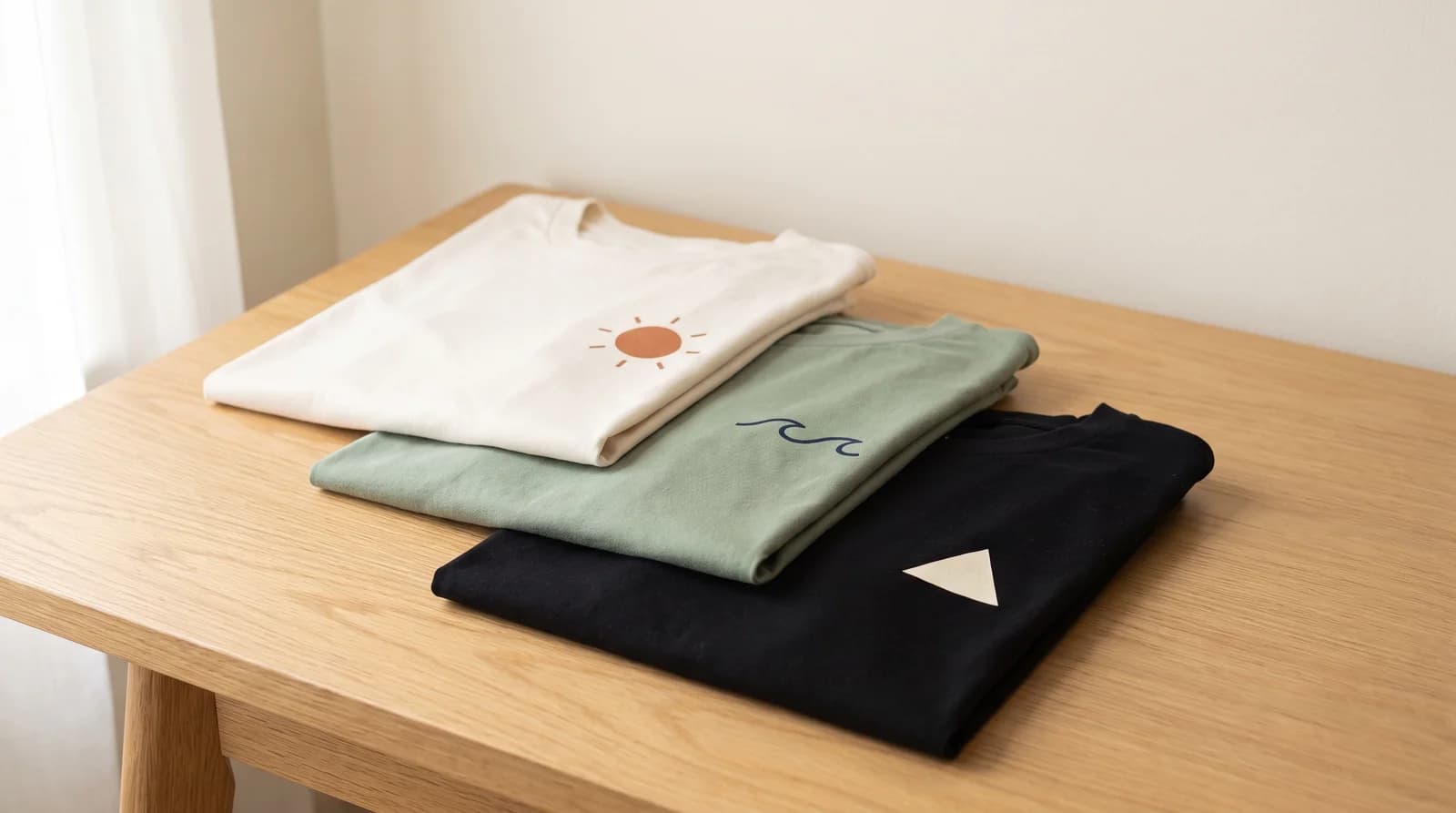
What to check when the sample arrives
- The blank: weight, softness, neck and stitching, and the fit on a real body. Note the label it carries: here is what a clothing label has to show if you replace it with your own.
- The print: position against your mockup (Printful’s disclaimers say minor placement variations occur across all techniques), color against your screen, and sharpness on the smallest text.
- The wash: wash it inside out, then check for cracking and fading.
- The size chart: measure the sample flat and write your own chart. Keep the sample as the reference later orders must match.
How do you get product photos for clothes you never hold?
The short answer
Three routes: the provider’s mockup (instant, but the same template other shops use), flat photos of your sample (real, but flat), or on-model photos of the real sample made with Tryly from a flat photo of it. On Etsy, list with the mockup and your own photo of the sample. Use the on-model photos on your own store, in ads and on social media.
The mockup is your print file laid over a stock photo of the blank. Buyers have seen that stock blank photo on many other listings, and it shows your file, not the print. The t-shirt mockups guide covers making better ones. For the real photo, lay your sample flat on a white sheet by a window and shoot from above with your phone, as in how to photograph clothes to sell.
On-model photos of the real sample, with Tryly
Upload the flat photo to Tryly’s AI clothing photography tool and the printed piece is put on a model in about 15 seconds. Choose one of 500+ models or upload your own model or yourself, pick the poses and a background, and the review step shows the credit cost before anything is spent. A 2K photo is one credit.
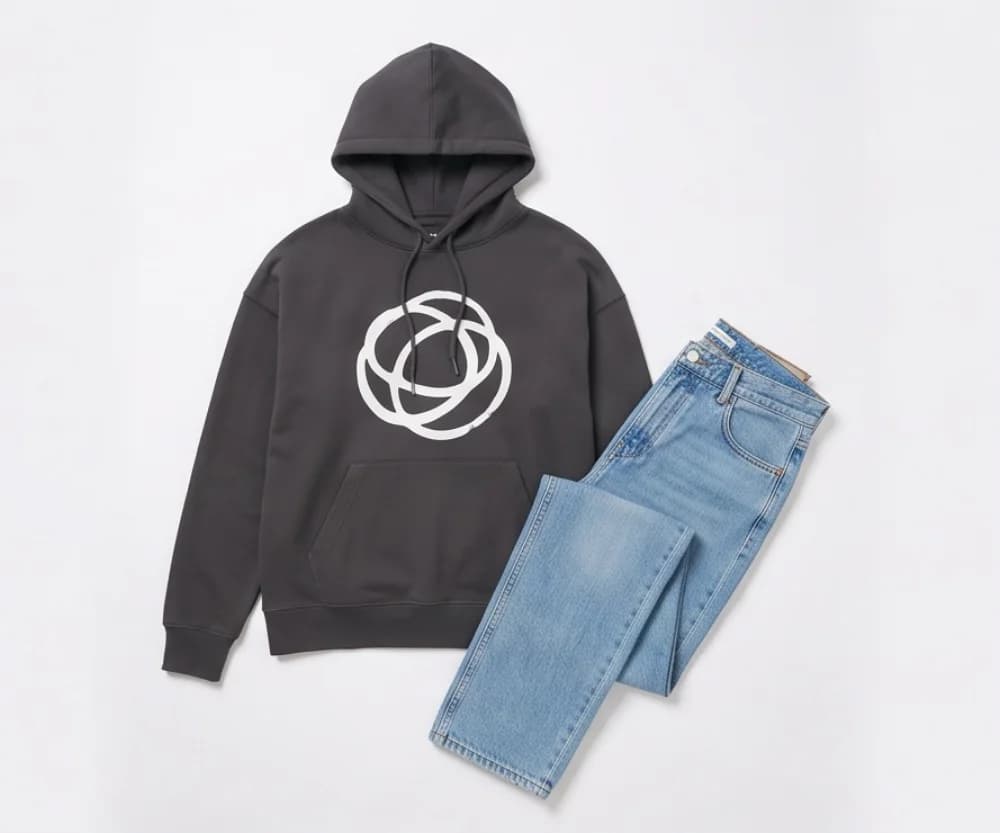 Before
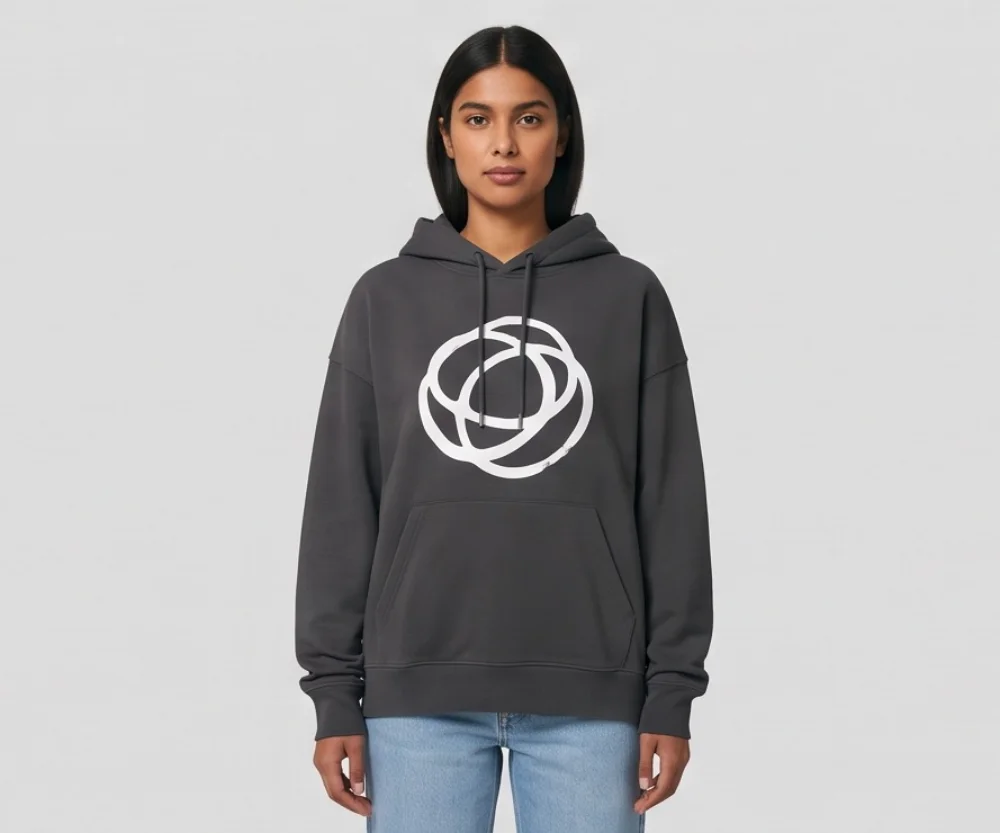 After
AfterOne model across the whole catalog
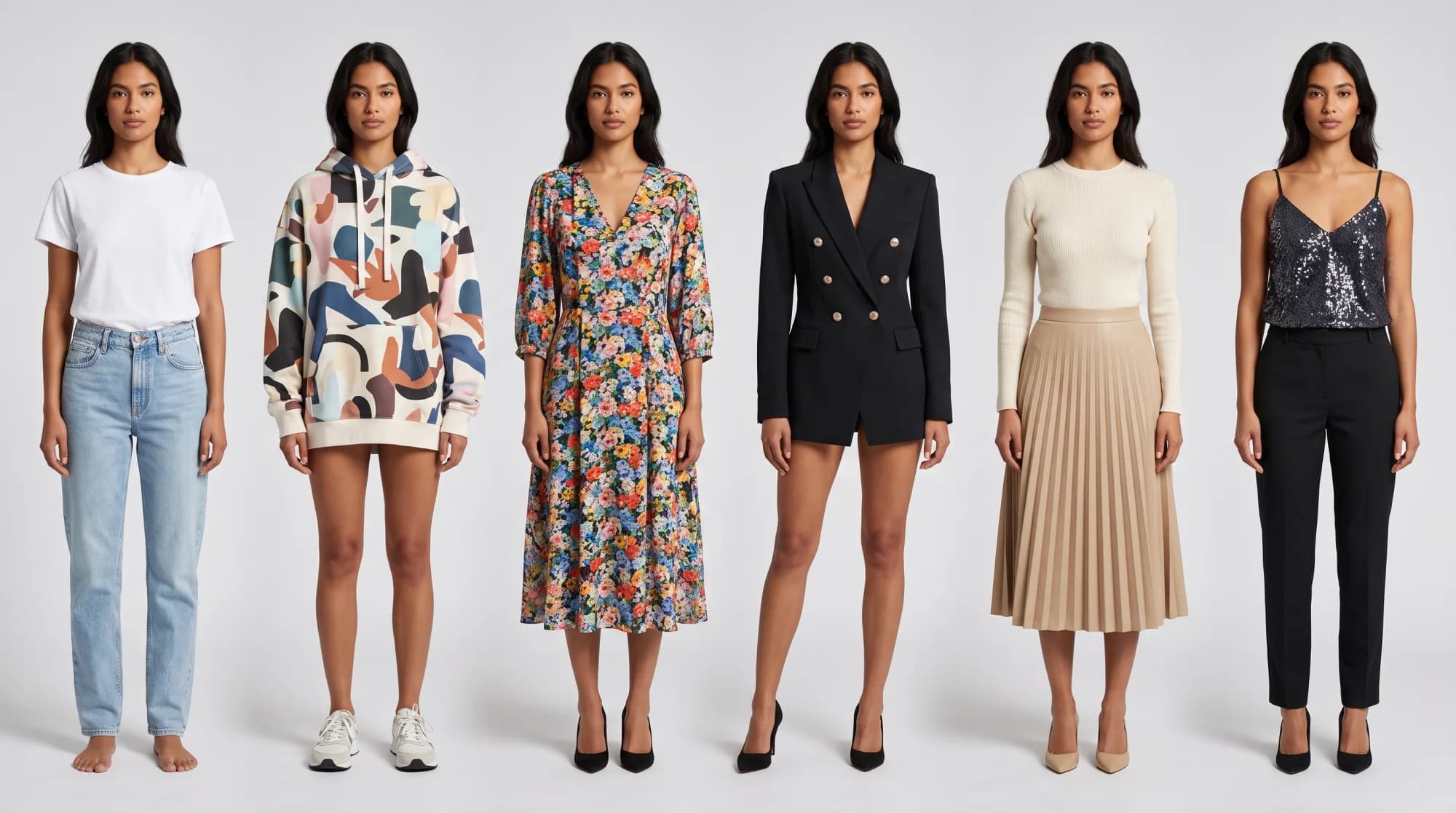
A catalog reads as a brand only when every design sits on the same person, background and crop. Pick one model and shoot the designs one at a time; on a paid plan a “Same model” button brings back the model from your last shoot. The collection demo shows ten garments on one model, then on a second model.
The test that matters
Try it on your hardest garment first.
Sellers judge an AI photo tool on the piece most likely to go wrong: a print, a logo, sheer fabric or a detail that has to sit exactly right. Check the result at full size before you publish it. Here: a black T-shirt with a “STUDIO 88” chest print.
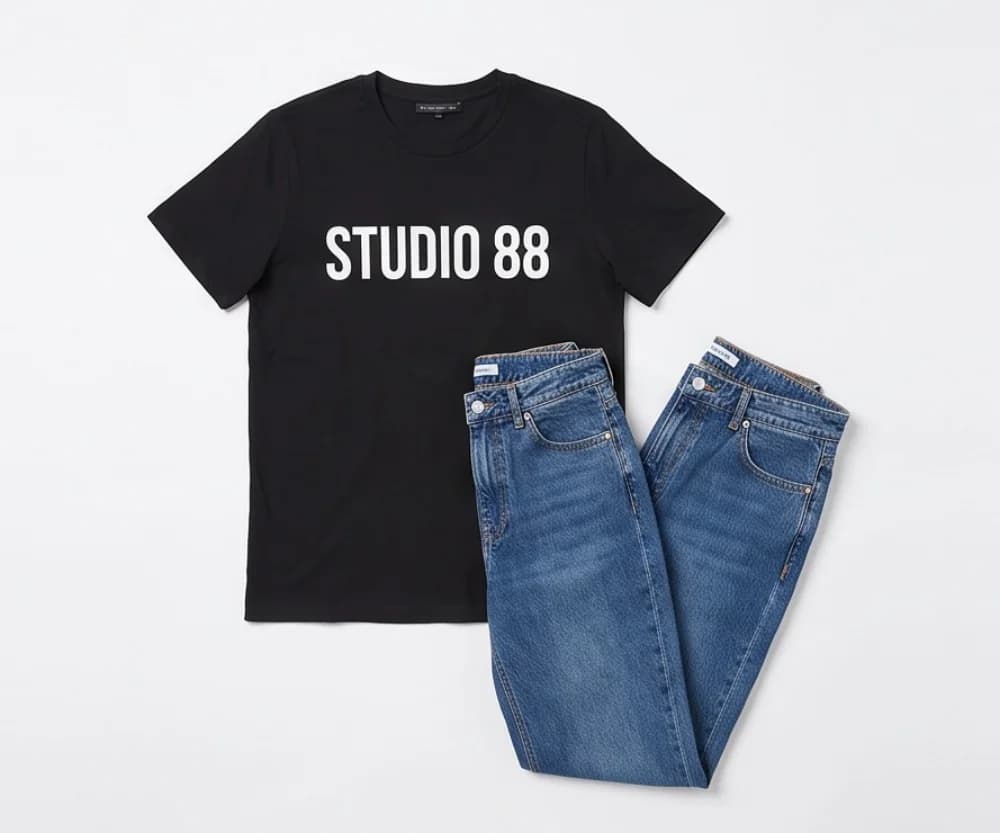
01 Product photo
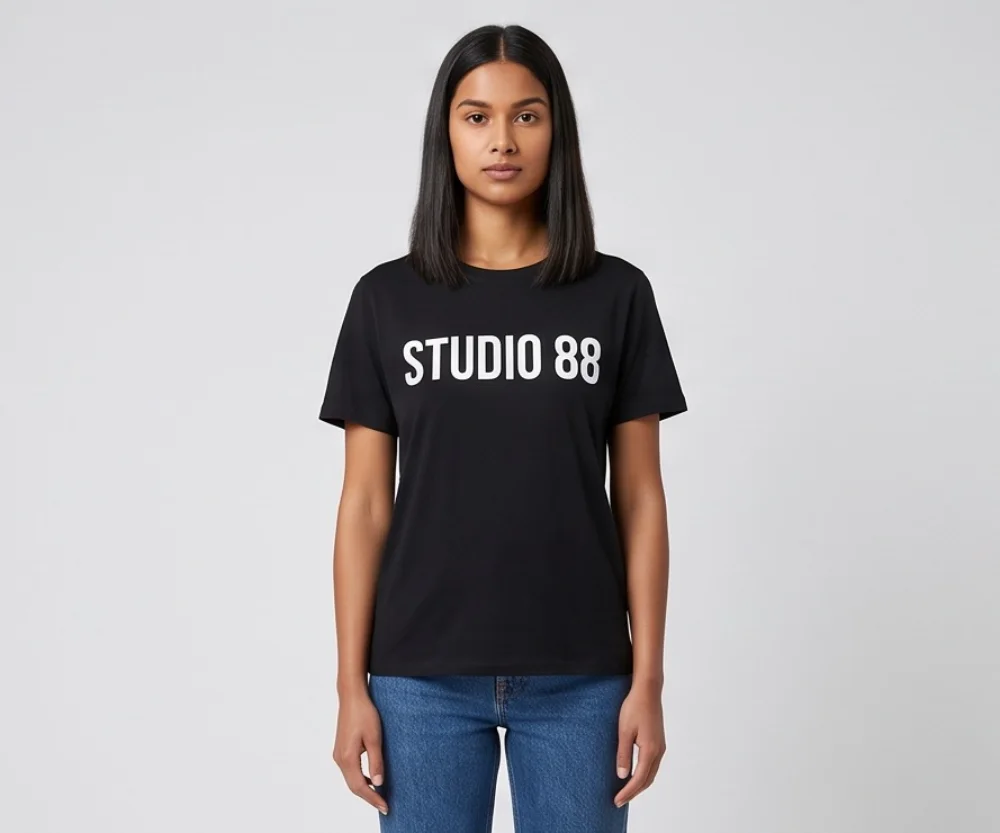
02 On the model
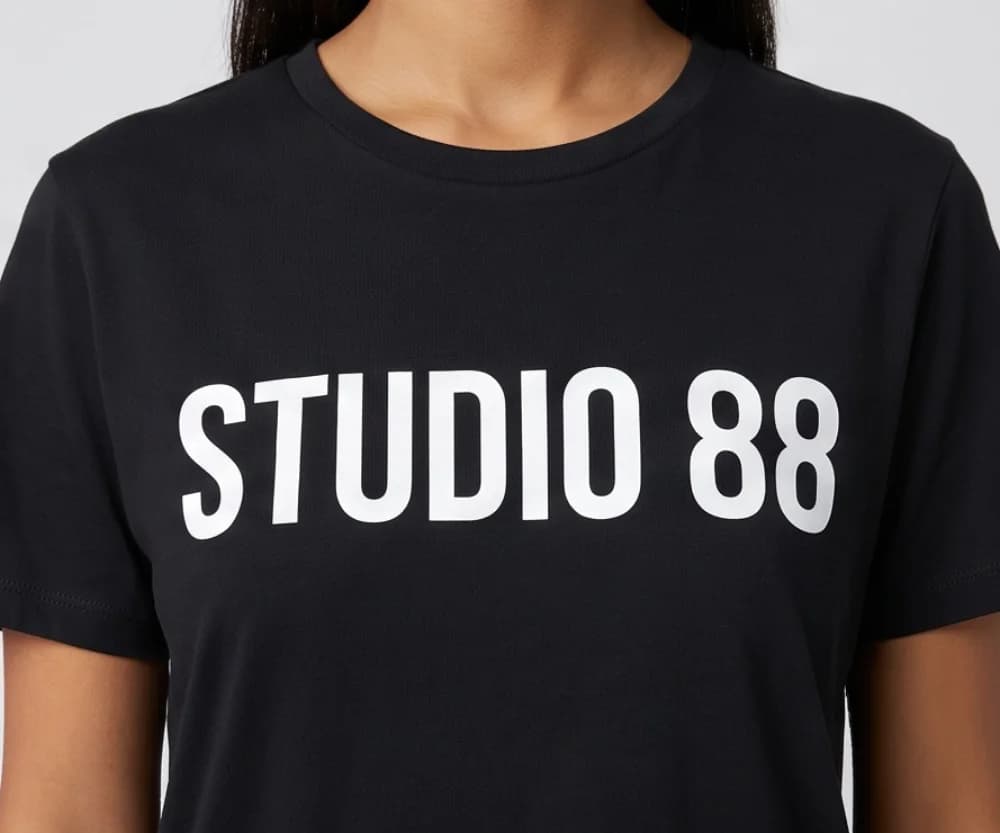
03 Full-size check
10 free photos, no card.
Photos made on a paid plan can be used on your store, in ads and on social media. Plans start from $9.99/month (Starter plan, billed annually), from $0.33 a day, with photos as low as $0.25 each: a 20-design catalog with a front photo on two blanks each is 40 photos, $10 at Tryly’s lowest rate. Start with 10 free photos, no card, on the design with the smallest text.
How do you list and launch a print on demand line?
The short answer
Every listing needs the blank’s facts, a size chart from your sample, the print method and its care, and the provider’s delivery estimate. Launch a small set of designs at once, on the same model.
- A title with the design, the product and who it is for, in the words buyers search.
- The blank’s brand, fabric and weight, and how it fits.
- A size chart measured from your own sample, laid flat.
- The print method and its care, such as washing inside out.
- A delivery estimate: the provider’s production time plus shipping time to that country.
- Photos: on Etsy, the mockup and your own photo of the sample; on your own store, one set on the same model and background (on-model front, print close-up, back and the flat sample).
- A test order to your own address, to check the packing slip and the label.
Each platform’s photo sizes and counts are in the product image size requirements. Eight to twelve designs at once look like a line; a lookbook grid of one model in every design doubles as your launch posts, and Instagram for clothing brands covers building a following first.
What are the most common print on demand mistakes?
The short answer
Designs without samples, prices without the fee and ad lines, text too small to print, the mockup as the only photo, a different look on every listing, and artwork you do not own.
- Fifty designs, no samples. Order one of every blank before you list any of them.
- Pricing from the base cost up. Add the platform fees and the ad cost per sale first.
- Small text and thin lines in the print file. Embroidery cannot stitch tiny letters legibly, and thin DTF lines can peel. Make them bigger or drop them.
- The mockup as the only photo. Add the real sample and an on-model shot.
- A different mockup template for every design. One model, one background and one crop across the catalog.
- A slogan that is someone else’s trademark, or a character you do not own. Print only what you have the right to print.
Questions about starting a t-shirt business with print on demand
How do you start a t-shirt business with no money?+
With print on demand. Printful and Printify charge nothing to open an account, have no order minimums and are paid per order after the sale. Your real costs are a sample of each blank, listing fees (plus Etsy’s one-time set-up fee where it applies) and product photos; on Tryly the first 10 photos are free, no card.
Is print on demand clothing profitable?+
Product by product: the retail price minus the base cost, the platform fees and the ad cost of each sale. On a tee the base cost takes a large share, so ads decide; hoodies and sweatshirts leave more room.
Which print on demand provider is best for clothing?+
There is no single best one. Compare the exact blank’s base cost, print methods, delivery times and sample and misprint policies, then order the same design from two providers and compare the samples.
Do I need to order samples?+
Yes, one of every blank you will sell, with your hardest design on it. Printful’s help center gives accounts with a connected store a 20% sample discount; Printify’s says sample orders are placed at regular pricing.
Can I use the provider’s mockups on Etsy?+
Yes, for this case. Etsy’s listing image requirements allow a stock photo mockup when a production partner prints your original design onto a base item such as a t-shirt. You must also disclose the production partner on the listing.
How do I get on-model photos when I never hold the stock?+
Photograph the sample you ordered flat by a window and upload it to Tryly; the printed piece goes onto one of 500+ models, or your own model or yourself. Keep that model for every design. Your first 10 photos are free, no card.
What file do I need for a print on demand shirt?+
Printful’s help center asks for at least 150 DPI for DTG, sized to the actual print dimensions, and 300 DPI for all-over print designs with fine lines, small details or text. Export in sRGB as PNG or JPEG and keep essential text inside the safe print area.
Sources: Printful print on demand, DTG, embroidery, all-over print and shipping, and Printful Help Center sample orders, DPI and print file size, 150 vs 300 DPI, safe print area, RGB or CMYK and printing disclaimers; Printify how it works and print on demand, and Printify Help sample ordering and decoration methods; Etsy Help production partners, Etsy fees policy and listing image requirements; Amazon Merch on Demand; USPTO trademark search.
Written by
Elena Varga
Head of Content, Tryly Academy
Former e-commerce photo producer who ran catalogue shoots for fashion labels for over a decade. Writes the Academy’s guides.
- 11 years in fashion e-commerce
- 1,200+ catalogue shoots produced
Expert review
Sofia Moretti
Fashion photographer · Expert reviewer
Has shot campaigns and on-model e-commerce for fashion brands for 14 years. Reviews every Academy article for accuracy.
- 14 years in fashion photography
- Campaign and catalogue work across Europe
How we work: every Academy article is written by a specialist, reviewed by a working fashion photographer, and re-checked against its sources when prices or rules change.