Guide
How to sell clothes on eBay: listing, photos, pricing, shipping and fees
How to sell clothes on eBay, from the first listing to the payout: title, item specifics, condition, photos, pricing, fees and shipping, each checked against eBay’s own pages.

 By Elena Varga
 · Reviewed by Sofia Moretti |Fact-checked|14 min read
Key takeaways
- 1Buyers find clothing on eBay through the title and item specifics. Use all 80 characters and fill every Required and Recommended specific, or filtered searches skip you.
- 2Pick the condition by eBay’s wording: Pre-owned - Excellent, Good or Fair. Add flat measurements in inches and centimeters, and photograph every flaw.
- 3Most clothing pays a 13.6% final value fee on the total sale plus $0.30 or $0.40 per order. The first 250 listings each month are free to list.
- 4eBay bans stock photos for used items and added text. Your own photos come first; an on-model photo made from them with Tryly can follow as an extra.
10 free photos, no card. Photos as low as $0.25 each.
On this page+
How do you sell clothes on eBay?
The short answer
To sell clothes on eBay, photograph the item on a plain background and list it with an 80-character title, every item specific, the right condition grade and flat measurements. Price it from what similar items sold for, then ship on an eBay Labels label within your handling time. Most clothing pays 13.6% of the total sale plus $0.30 or $0.40 per order when it sells.
Still choosing a platform? Where to sell clothes online compares eBay with the resale apps, and how to become a clothing reseller covers the business side.
How do you set up to sell on eBay and get paid?
The short answer
Create an eBay account, then link a checking account in the Payments tab of Seller Hub; the name and address on the bank account should match your eBay account. eBay deducts its fees before paying you and generally makes funds available within 2 days of confirming the buyer’s payment.
eBay’s payments and earnings page lets you choose daily, weekly, biweekly or monthly payouts; your bank generally takes another 1–3 days. You can buy shipping labels from available funds, so you never wait for a payout to ship. Express payouts to a Visa or Mastercard debit card arrive in minutes, for a fee.
What clothing sells on eBay?
The short answer
Clothing that buyers search for by name sells best on eBay: known brands, specific styles, vintage, sneakers and designer bags. eBay’s condition grades cover women’s, men’s, kids’ and baby clothing, vintage, wedding and formal wear, costumes and traditional dress.
eBay works like a search engine: a buyer types “Patagonia fleece men’s large” and eBay matches it against titles and item specifics. A piece does best when there is something to type: a brand, a model name, a fabric, an era, a hard-to-find size. Plain, no-name pieces give buyers nothing to search for, so they usually do better grouped into a bundle. The full category list is in eBay’s pre-owned fashion guidance.
How to write an eBay clothing listing, step by step
The short answer
An eBay clothing listing has five parts that decide whether buyers find it: an 80-character title, item specifics, the condition grade, a description with measurements, and photos. Fill every one; eBay’s search and filters read them all.
The title: 80 characters
eBay’s Create great listings page: “You’ve got 80 characters to use, so use as many as you can in your title.” Include the brand, item type, color and style; its Selling clothes page adds size and material, and warns against all caps, special characters and acronyms buyers may not understand.
Item specifics for clothing
Item specifics are eBay’s descriptive keywords: brand, size, length, type, color, style. eBay’s item specifics page says your item will only appear in a filtered search if you added the matching specific. Every Required one must be filled before you can list; fill every Recommended one that applies too.
Condition: eBay’s grades for clothing
An unworn piece with visible flaws is listed as New with imperfections, per eBay’s seller update. Worn clothing takes one of three grades from eBay’s pre-owned condition page:
| Condition | eBay’s definition |
|---|---|
| Pre-owned - Excellent | Like-new items that have been previously worn, but with little-to-no signs of wear. |
| Pre-owned - Good | Gently-used fashion items with light signs of wear, with or without visible flaws. |
| Pre-owned - Fair | Significantly visible flaws, heavy signs of wear, and/or missing or damaged components. |
Buyers filter by condition too. When in doubt, grade down: a “Good” sweater that arrives looking excellent never comes back.
The description, with measurements
The Selling clothes page asks for condition, size, color, material, brand, the fiber percentages of a blend, and every flaw with a photo, “from a small hole in the item to a stain”. It also asks for measurements in inches and centimeters:
| Item | What eBay suggests measuring |
|---|---|
| Men’s shirts | Chest from armpit to armpit; sleeve from the center of the neck to the end of the cuff |
| Dresses | Waist and dress length |
| Pants and shorts | Inseam |
| Shoes | Length and width of the shoe |
How to measure clothes for selling has the flat method for each garment.
What photos does an eBay clothing listing need?
The short answer
An eBay clothing listing takes up to 24 photos of the actual item, about 1600 × 1600 pixels, with the whole piece face-on as the main photo. eBay’s picture policy bans photos that don’t accurately represent the item, stock photos for used items, and added borders, text or watermarks.
eBay’s picture policy lists what is not allowed, word for word:
- “Photos that don’t accurately represent the item”
- “Placeholder images used to convey messages”
- “Stock photos for used, damaged, or defective items”
- “Photos with added borders”
- “Photos with added text, artwork or marketing material”
- “Watermarks of any type, including those used for ownership attributions”
Photos must be at least 500 pixels on the longest side. The policy doesn’t say you must take every photo yourself, but eBay acts on content that disrespects third-party rights, from removing the listing to suspending the account. Copying another seller’s photos is the usual way sellers run into it.
The shots for a clothing listing
eBay’s adding pictures page takes files up to 12 MB and shows the main photo in search results. The Selling clothes page asks for a solid background (light for dark clothes, dark for light ones), natural light and every angle.
- Main photo: the whole garment, front, face-on.
- Then: back, sleeve, collar, buttons, brand and size labels, the care label with the fabric content, a fabric close-up.
- Every flaw in a clear close-up; eBay says this sets expectations and prevents returns.
- Scale: a tape measure across the chest or waist, or a ruler beside a small piece.
Window light from one side and a white board opposite fill the shadows; after dark, two matched lamps do the same job (see product photography lighting). The full phone method is in how to photograph clothes to sell.
How do you price clothes on eBay?
The short answer
Price clothes on eBay from what the same or similar items actually sold for, not from asking prices. The Selling clothes page points to eBay’s research tools, which show sold prices from the last 7 days up to 3 years. Then list at Buy It Now with Best Offer on, or as an auction for rare pieces.
Product Research, eBay says on its research tools page, is free to all sellers under the Research tab in Seller Hub.
Buy It Now or auction
The Create great listings page suggests auctions for rare, limited edition or high-demand items, and a fixed price for multiple items or variations such as size. A sought-after vintage jacket can run as an auction; a good-brand sweater is a Buy It Now.
Best Offer and Offers to Buyers
eBay’s offers page describes Best Offer as a way to “make a faster sale and test the pricing”, with rules to auto-accept or auto-decline. Offers to Buyers works the other way: a discount of at least 5% you send to people watching an item or holding it in their cart. Price a little above the number you will take, so a counteroffer still lands where you want.
How do Promoted Listings work for clothing?
The short answer
Promoted Listings are eBay’s optional ads. With the general strategy you pay an ad rate only when the item sells after a click on your ad; with the priority strategy you pay for clicks, within a daily budget.
Both are set out on eBay’s Promoted Listings page. For one-off clothing, a low-risk start is the general strategy on a few listings. The ad fee comes on top of the final value fee, so put it in your price math first.
What are eBay’s fees for selling clothes?
The short answer
eBay charges most clothing a final value fee of 13.6% of the total amount of the sale up to $7,500, plus $0.30 per order at $10 or less and $0.40 above. The first 250 listings a month have no insertion fee; after that, $0.35 each.
The figures are from eBay’s selling fees page, which says the total amount of the sale includes “the item price, any handling charges, any shipping costs collected from the buyer, sales tax, and any other applicable fees.” So a shipping charge raises your fee just as free shipping built into the price does.
| Category | Final value fee |
|---|---|
| Most clothing (the “most categories” rate) | 13.6% of the total sale up to $7,500, 2.35% on the portion over $7,500 |
| Athletic shoes | 8% if the total sale is $150 or more, with no per-order fee; 13.6% below $150 |
| Women’s bags and handbags | 15% if the total sale is $2,000 or less; 9% above $2,000 |
| Most jewelry and watches | 15% if the total sale is $5,000 or less; 9% above $5,000 |
The per-order fee applies in every row except athletic shoes at $150 or more. The clothing rate at a few totals:
| Total amount of the sale | 13.6% + per-order fee | Final value fee |
|---|---|---|
| $10 | $1.36 + $0.30 | $1.66 |
| $20 | $2.72 + $0.40 | $3.12 |
| $40 | $5.44 + $0.40 | $5.84 |
| $80 | $10.88 + $0.40 | $11.28 |
| $150 | $20.40 + $0.40 | $20.80 |
eBay’s Seller Center fees page works a clothing example: a skirt that sells for $85.60 after sales tax pays $12.04 (13.6% plus $0.40). The help page adds 6% to final value fees for sellers rated Below Standard, and 5% for a high rate of “item not as described” returns.
How do you ship clothes sold on eBay?
The short answer
eBay sellers ship clothes themselves. Choose free, calculated or flat-rate shipping when you list, buy the label in eBay Labels, and get the package scanned within the handling time you promised. Most clothes travel in a light, waterproof mailer.
eBay’s Preparing your shipment page gives three settings:
| Setting | How it works | Fits |
|---|---|---|
| Free shipping | You pay the label; build the cost into the price. | Buyers often expect it. The fee still counts the item price you set. |
| Calculated | eBay sets the buyer’s charge from their location, your package details and the service. | One-off pieces with very different weights: a coat and a camisole. |
| Flat rate | One shipping cost you choose. | Similar items, such as T-shirts, that pack the same way. |
Labels and packaging
With no printer, eBay Labels can give you a QR code to print the label at the drop-off. eBay’s USPS and eBay Labels page prices USPS Ground Advantage in weight steps up to 15.999 oz, then by the pound. Round every weight and size up, per eBay’s packaging and measuring page, or the carrier adjusts the label. See the cheapest way to ship clothes.
Handling time
eBay’s handling time page defines it as the days between receiving payment and the carrier’s scan. Same-day or 1-day handling with at least a 30-day money-back return policy can help you earn the Top Rated Plus discount and seal.
Returns
eBay’s returns page suggests a window such as 30 or 60 days. When an item comes back because it is the wrong size, fit or doesn’t match the description, you must accept the return and pay return shipping; eBay refunds the final value fee once you refund the buyer. Measurements and flaw photos keep those returns rare.
How does eBay’s Authenticity Guarantee work for sneakers and bags?
The short answer
eBay’s Authenticity Guarantee sends eligible sneakers and designer bags to authenticators before the buyer gets them, at no cost to the seller. Select sneaker brands and models qualify from $75; eligible handbags and accessories are checked free at $500 and up, with an optional $40 buyer add-on from $200 to $499.99.
The details are on eBay’s sneaker page and handbag page. The authenticators check the item against your title, description and photos. For eligible sneakers, eBay’s seller page offers a free FedEx label and requires a handling time of 3 business days or less.
Can you add an on-model photo to an eBay listing?
The short answer
Yes, an on-model photo can go in an eBay listing as an extra photo, as long as it accurately represents the item and carries no borders, text or watermarks. Your own photos of the actual item stay first; an on-model photo made from them with Tryly follows to show fit.
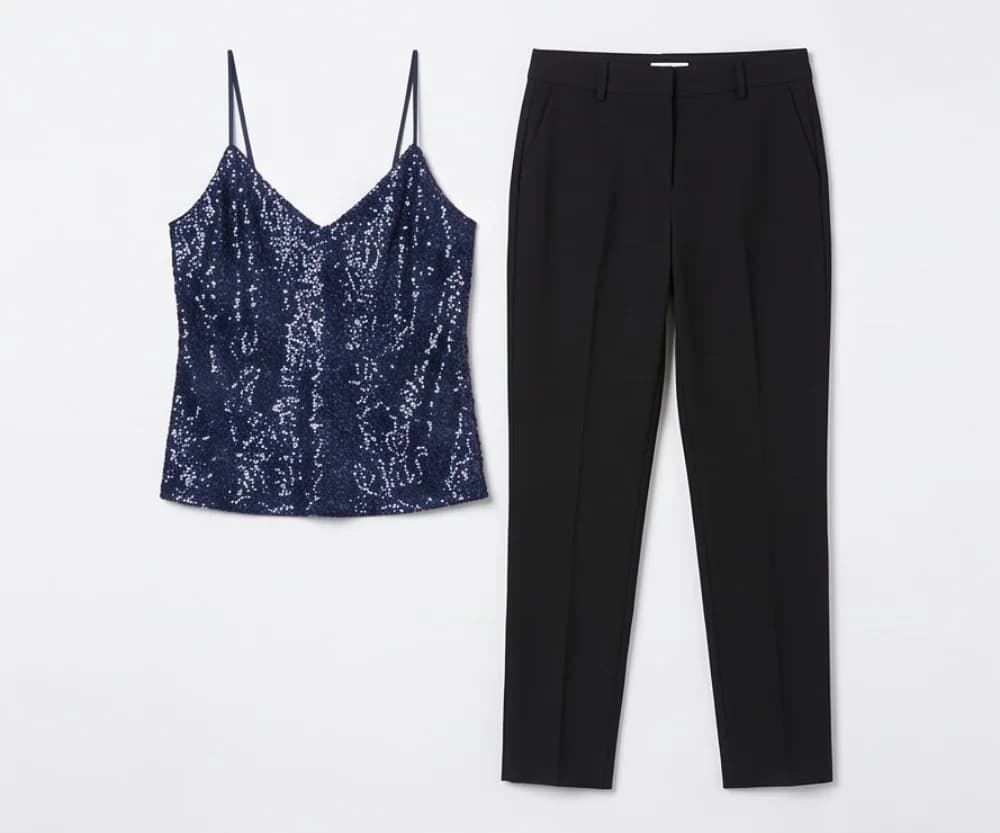
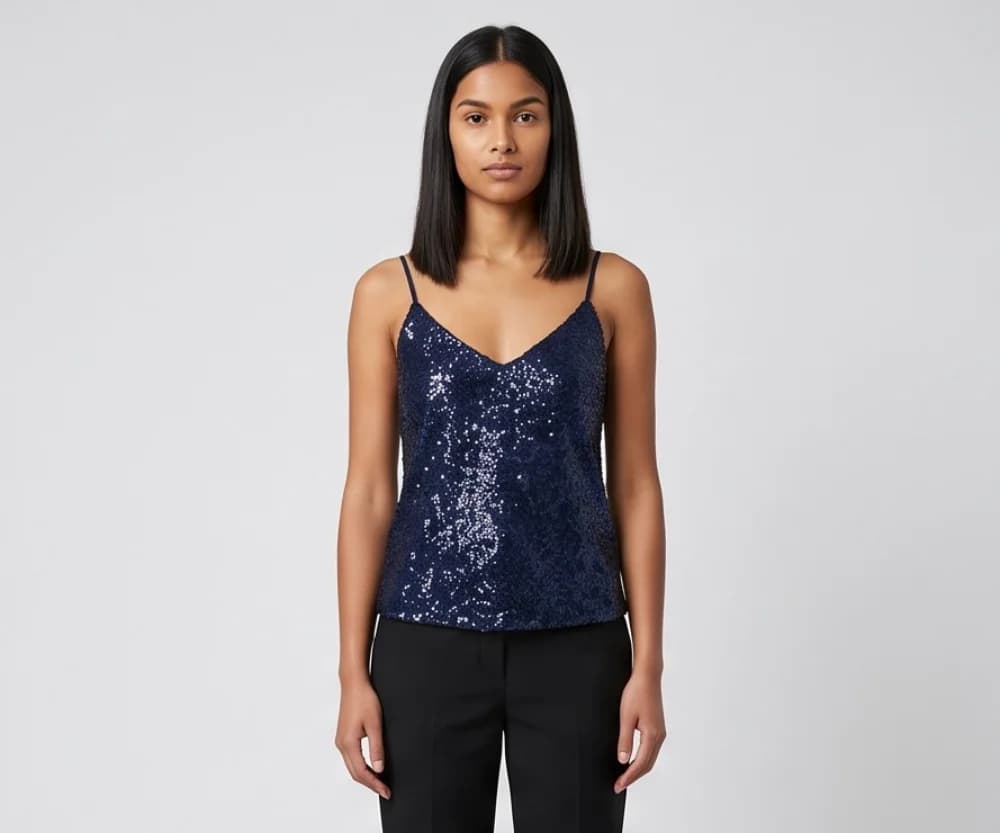
A flat photo doesn’t show how a piece hangs on a body. With Tryly, you upload the flat or hanger photo you took for the listing, choose a model, the pose and the background, and get the on-model photo in about 15 seconds. Pick from 500+ models, or use your own model or yourself.
 Before
 After
AfterHow to use it within eBay’s rules:
- Your photo is the main photo. Put the on-model photo after your own front, back, label and flaw photos.
- It must match the item exactly. Hold the piece next to the screen: color, print, logo, seams, buttons and length. If anything differs, don’t post it.
- Condition lives in your own photos. Wear, pilling and stains belong in your close-ups; the on-model photo answers “how does it fit”.
- Say what is included. The model may wear other pieces, so name the item for sale in the description.
The test that matters
Try it on your hardest garment first.
Sellers judge an AI photo tool on the piece most likely to go wrong: a print, a logo, sheer fabric or a detail that has to sit exactly right. Check the result at full size before you publish it. Here: a black crew-neck T-shirt with a large white STUDIO 88 print, photographed flat beside a pair of blue jeans.
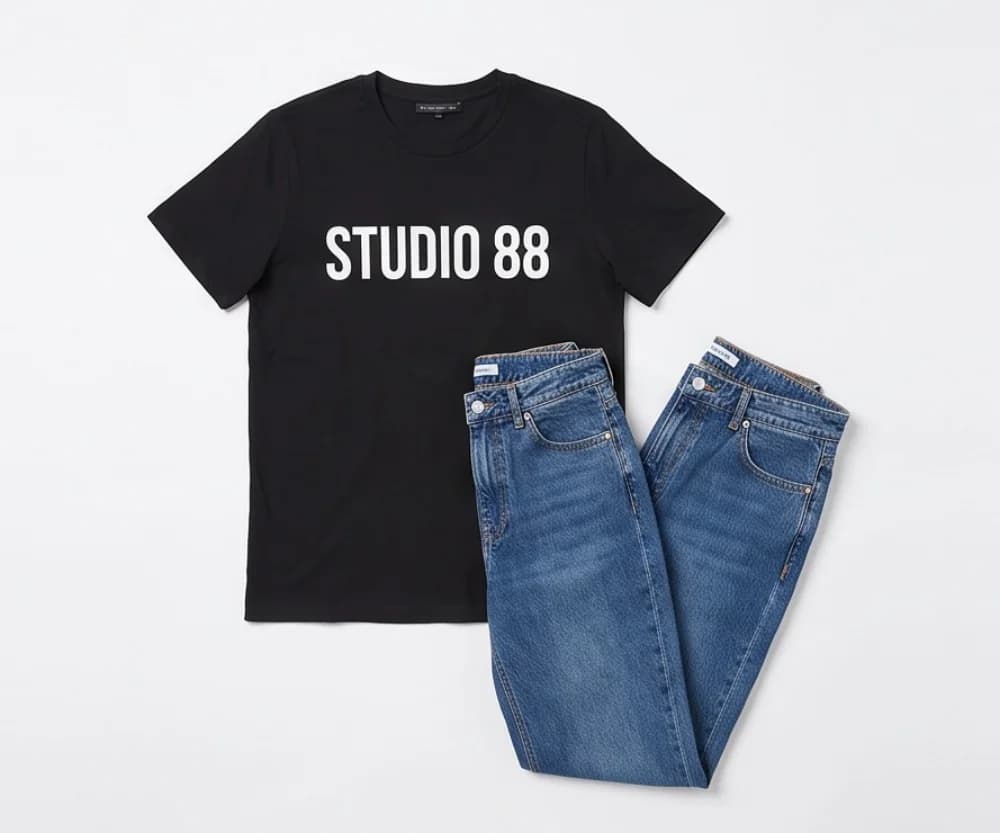
01 Product photo
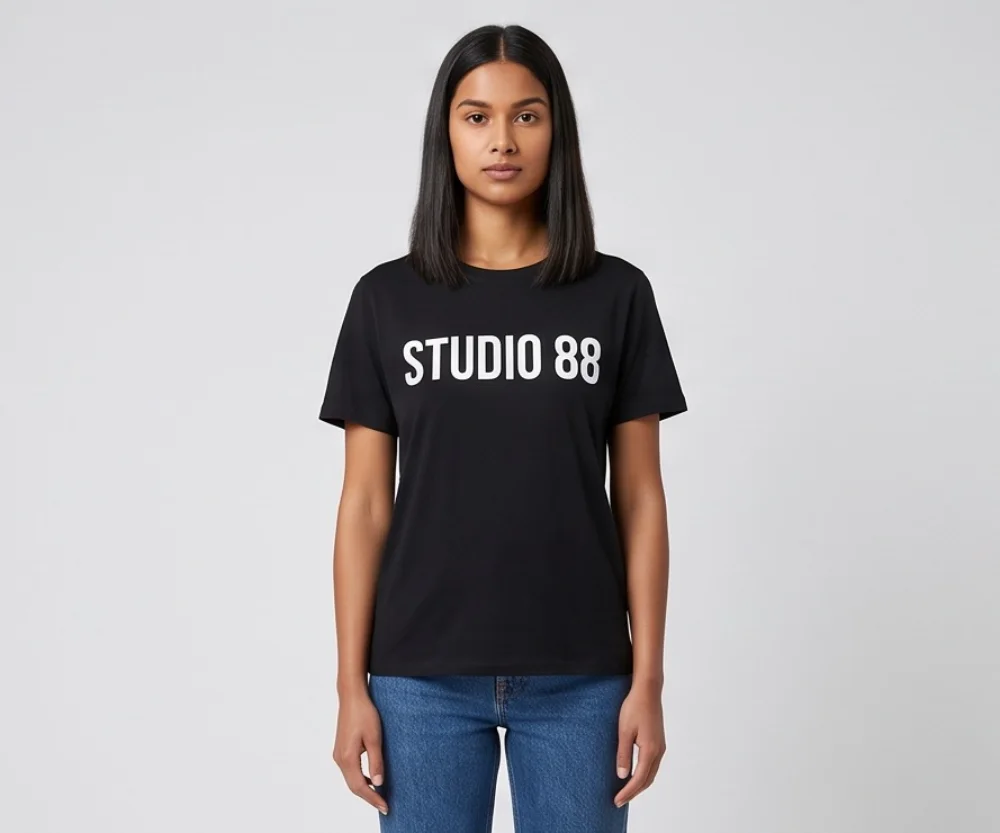
02 On the model
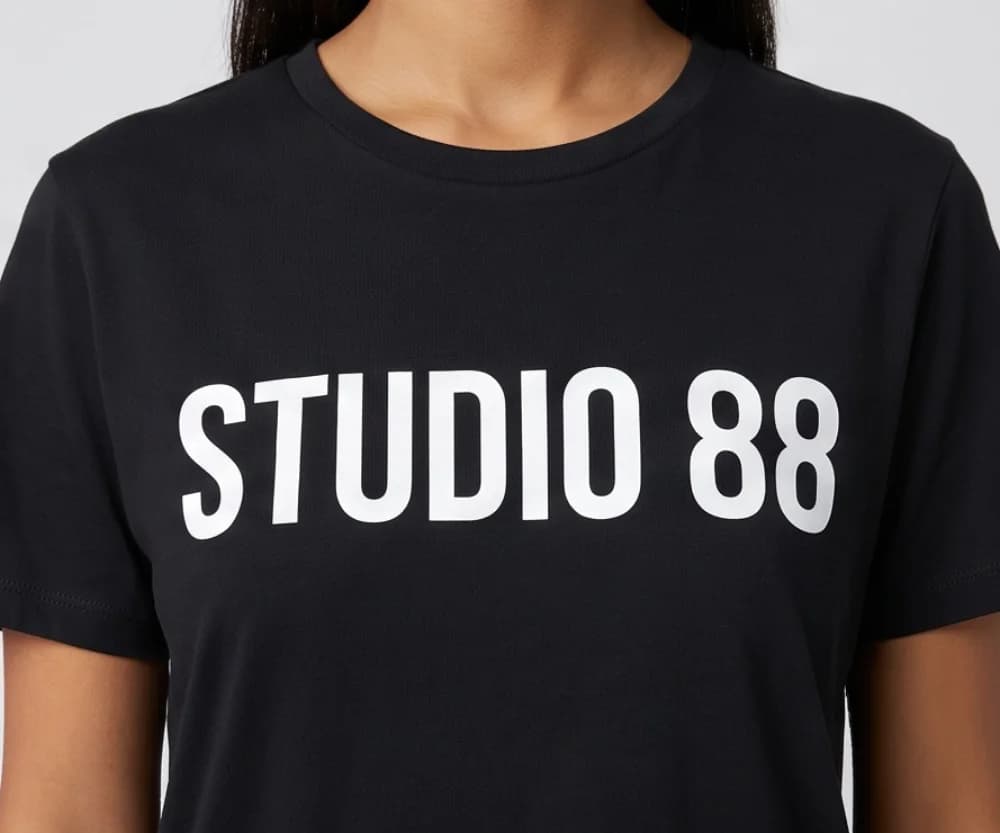
03 Full-size check
10 free photos, no card.
Photos made on a paid plan can also be used on your store, in ads and on social media, and Poshmark accepts one as an extra after your own cover shot. Plans start from $9.99/month (Starter plan, billed annually), from $0.33 a day; at Tryly’s lowest rate of $0.25 a photo, on-model photos for 100 listings cost $25.
How to make money selling clothes on eBay: the mistakes to avoid
The short answer
Making money selling clothes on eBay comes down to being found and avoiding returns: full titles and item specifics, honest grades, measurements, your own clear photos and on-time shipping. Each mistake below costs visibility or a refund.
| Mistake | Fix |
|---|---|
| A short title. | You have 80 characters. Brand, type, style, color, material and size all belong in it. |
| Empty item specifics. | A buyer who filters by size or brand never sees a listing that skips them. |
| Grading “Good” as “Excellent”. | Pick the grade by eBay’s wording above; an inflated grade invites an item-not-as-described return. |
| No measurements. | Sizes aren’t standardized. Measure flat and give inches and centimeters. |
| Other people’s photos, or text on yours. | eBay bans stock photos for used items, added text and watermarks. Photograph the piece you are selling. |
| A guessed weight. | Put the packed parcel on a scale and round up; the carrier can adjust an under-declared label. |
| A handling time you can’t keep. | Promise the quickest time you can meet every time, not the quickest one on the menu. |
Selling clothes on eBay: questions sellers ask
How much does eBay take when you sell clothes?+
For most clothing, eBay keeps a final value fee of 13.6% of the total amount of the sale up to $7,500, plus $0.30 per order at $10 or less and $0.40 above. The total includes the item price, shipping charged to the buyer and sales tax. Athletic shoes pay a lower 8%, with no per-order fee, once the total reaches $150.
Is it free to list clothes on eBay?+
Mostly. The first 250 listings you create each month carry no insertion fee, or more if you have an eBay Store. Beyond that, most listings cost $0.35 each. The final value fee is charged only when the item sells.
How many photos can an eBay clothing listing have?+
Up to 24. eBay requires at least one photo of at least 500 pixels on the longest side and recommends about 1600 × 1600. The main photo appears in search results and should show the whole item face-on.
Can you use stock photos to sell used clothes on eBay?+
No. eBay’s picture policy does not allow “Stock photos for used, damaged, or defective items”, and listings that break it can be removed. Photograph the piece you are selling.
Can I add an on-model photo to my eBay listing?+
As an extra. eBay’s picture policy doesn’t require photos you took yourself, but every photo must accurately represent the item, with no added borders, text or watermarks. Keep your own photos of the actual item first, then add an on-model photo made from them with Tryly if it matches the item exactly. Try it with 10 free photos, no card.
When does eBay pay you for a sale?+
eBay generally makes funds available within 2 days of confirming the buyer’s payment, then pays them to your bank on the schedule you choose: daily, weekly, biweekly or monthly. Your bank generally takes another 1–3 days.
Sources, all eBay: picture policy, adding pictures, selling fees, selling clothes, pre-owned conditions, payments, shipping settings and returns, plus the pages linked in each section. These pages change; follow the links if a number matters to you.
Written by
Elena Varga
Head of Content, Tryly Academy
Former e-commerce photo producer who ran catalogue shoots for fashion labels for over a decade. Writes the Academy’s guides.
- 11 years in fashion e-commerce
- 1,200+ catalogue shoots produced
Expert review
Sofia Moretti
Fashion photographer · Expert reviewer
Has shot campaigns and on-model e-commerce for fashion brands for 14 years. Reviews every Academy article for accuracy.
- 14 years in fashion photography
- Campaign and catalogue work across Europe
How we work: every Academy article is written by a specialist, reviewed by a working fashion photographer, and re-checked against its sources when prices or rules change.