Guide
Vintage clothing labels: how to date clothes by the tag
Care labels, fiber content, ZIP codes, union labels, RN numbers and CC41: what each clue on a label really tells you about a garment’s age, with the law, museum or archive behind every date.

 By Elena Varga
 · Reviewed by Sofia Moretti |Fact-checked|13 min read
Key takeaways
- 1Read every label, not just the brand. On a US piece, care instructions point to after July 1972, fiber percentages on a non-wool piece to after March 1960, and a five-digit ZIP code to after July 1963.
- 2The newest clue sets the earliest date the piece could be. Give the era as a range, such as “circa 1970s”, and say which clues you used.
- 3An RN number names the company, not the year. Photograph every label, readable and in daylight: several platforms ask for it.
10 free photos, no card. Photos as low as $0.25 each.
On this page+
How do you date vintage clothing labels?
The short answer
Date vintage clothing labels by clues that only exist after a known date. On a US garment, care instructions point to after July 1972, fiber percentages on a non-wool piece to after March 1960, a five-digit ZIP code to after July 1963, and care symbols with no words to 1997 or later. The newest clue sets the earliest possible date.
Many vintage label tips online have no source, and some are wrong. Every date in the chart below links to its source in the row: the law itself, a government office, a museum, a university archive or the brand’s own release. Tips that don’t hold up are in the myths section.
One caution first. The care, fiber and origin dates are US rules. A piece made for Britain, Europe or Japan followed other laws, so use the brand, construction and country clues for those.
Vintage clothing tags dating chart: if the label has this, it was likely made then
The short answer
Each clue below sets a limit on a garment’s age. Most say “not before” a date, a few say “not after”. Use several together: one clue gives a limit, three clues give an era.
| If the label has… | It was likely made… | Why, and the source |
|---|---|---|
| Care instructions (washing, drying, ironing, drycleaning) on a US garment | Likely after July 1972 | The FTC’s Care Labeling Rule was issued in December 1971 and, per the Federal Register, took effect for garments leaving the factory on July 3, 1972. |
| Care symbols only, with no words | Likely 1997 or later (US) | The FTC allowed the ASTM symbols “in lieu of words” from July 1, 1997, per its 1997 notice. Before that, US care labels had to use words. |
| Fiber percentages on a piece with no wool, e.g. “65% polyester, 35% cotton” | Likely after March 1960 | The Textile Fiber Products Identification Act, which requires “the percentage of each fiber present, by weight”, was signed on September 2, 1958 and took effect 18 months later. Wool pieces had content labels earlier (next row). |
| Wool content, e.g. “100% wool” | After mid-1941, if the piece is wool | The Wool Products Labeling Act passed on October 14, 1940 and took effect nine months later. A wool piece with no content label may be older. |
| A fur content label on a fur piece | After August 1952 | The Fur Products Labeling Act passed on August 8, 1951 and took effect one year later. |
| A five-digit ZIP code in the maker’s address | After July 1963 | USPS history: the ZIP Code was introduced on July 1, 1963. |
| A two-letter state code in capitals, no periods, e.g. “CA”, “TX”, “IL” | After October 1963 | The same USPS page: the two-letter codes were settled in October 1963. Before that, the post office used “Calif.”, “Tex.” and “Ill.”. Nebraska was “NB” until 1969, then “NE”. |
| A two-digit city zone, e.g. “New York 1, N.Y.” | Roughly 1943 to 1963 | Two-digit postal zones for large cities started in 1943, says a USPS Inspector General paper, and the ZIP Code built on them in 1963. |
| “Made in U.S.A.” on an American-made piece | Not a date on its own: required only from late 1984 | A 1984 amendment to the Textile Act made US-made products say so, from 90 days after September 24, 1984. Earlier labels could say it too: the ILGWU label did from 1974 (next row). |
| An ILGWU union label | US-made; design narrows it (1959, 1963, 1974); before the 1995 merger | Cornell’s ILGWU union label timeline: new label launched January 9, 1959; redesigned in 1963 to stress “union made”; red, white and blue with “Made in the U.S.A.” from 1974; the union merged into UNITE in 1995. |
| The CC41 mark (UK) | 1941 to 1952 | The Imperial War Museum: compulsory on Utility cloth and clothes from autumn 1941. The V&A dates the Utility scheme 1941 to 1952. |
| “Made in W. Germany”, “USSR” or “Czechoslovakia” | Likely no later than 1990, 1991 and 1992 respectively | Office of the Historian: Germany reunified by October 1990 and the USSR dissolved on December 25, 1991 (source); Czechoslovakia ceased to exist on December 31, 1992 (source). |
| A © year printed with a T-shirt graphic | That year or later | A copyright notice gives the year the design was first published (Copyright Office Circular 3). The shirt can’t be older, but it can be a later print. |
| “Lyocell” in the fiber content | Likely 1992 or later (US) | The FTC gave the fiber a temporary designation in April 1992 and formally approved the name for fiber content labels in April 1996. |
| A Hanes undershirt with no sewn-in neck tag (“Tagless”) | Likely 2002 or later | Hanes says it introduced Tagless undershirts to the market in 2002 (company release). |
Read “after” as “not before”. Factories used up old label stock and brands kept an address for years, so a clue proves the piece is no older than that date, not that it was made that year.
How to read vintage garment labels, step by step
The short answer
Check that each label is original, read the brand label, then the care and content label, look up any RN number, note union, government and address clues, and combine them into a date range.
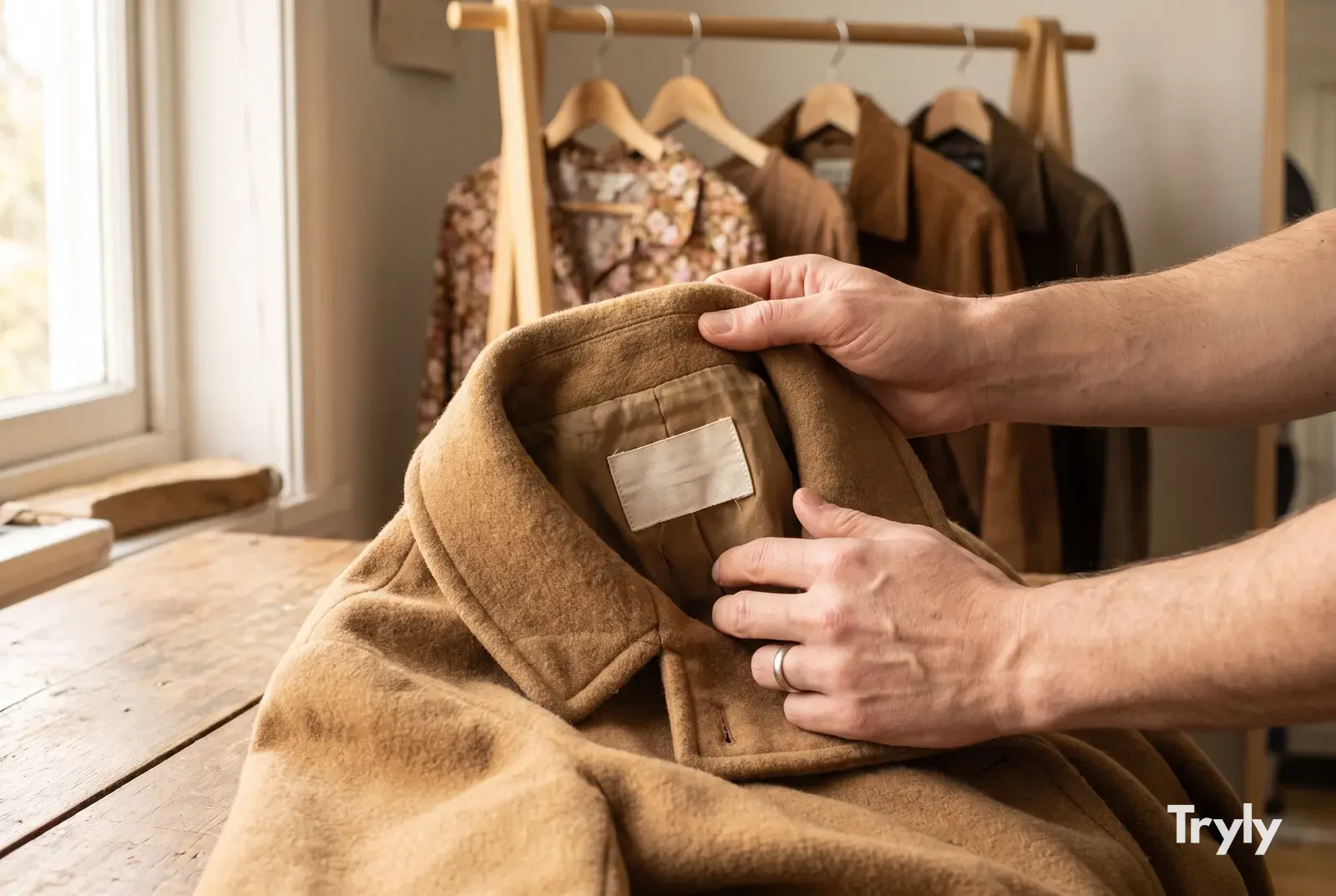
- Check the label is original. Look at the stitching that holds each label in. Original labels are sewn with the same thread and stitch as the seam around them; a label with new thread may have been moved or added.
- Read the brand label. Note the brand name, the logo, whether the label is woven or printed, and any address, then compare it with dated examples of that brand’s labels.
- Read the care and content label. Check for care instructions, care symbols, fiber percentages and the country of origin, and match each against the dating chart.
- Look up the RN or WPL number. Search the FTC RN database with the number only, leaving out the letters RN or WPL, to find the company behind the label.
- Look for union, government and address clues. Union labels, the CC41 mark, ZIP codes, state codes and country names each set a limit on how old or new the piece can be.
- Combine the clues. The newest clue sets the earliest possible date and the oldest-only clue sets the latest; give the era as a range with “circa” and list the evidence in the listing.
Combine the clues: the newest one wins
Say a dress has an ILGWU label in red, white and blue, a care label in words, and a maker’s address with a ZIP code. The ZIP code says after 1963, the care label after 1972, and the red, white and blue label 1974 or later, and the union merged in 1995. So: circa 1974 to the mid-1990s.
Using the RN number on a vintage tag
An RN is a number the FTC issues to a US business that makes, imports, distributes or sells textile, wool or fur products. Type the digits into the FTC RN database, without the letters “RN” or “WPL”, and it shows the company that holds the number.
The FTC’s RN FAQ says it no longer issues WPL numbers, the older ones for wool products, but many are still in use. It issues only one RN per company, so the number tells you who, not when. The database is also only as current as each company keeps it.
How to date a vintage T-shirt by the tag
For a vintage shirt tag, work through these in order:
- The neck tag. Blank-tee brands changed their tag designs over the years, so compare the logo, colors and wording with dated examples.
- Fiber, care and origin. The chart dates apply: percentages after 1960, care words after 1972, symbols only from 1997.
- The graphic. A © year is the year the design was first published, so the shirt is that year or later.
- A tagless neck. Hanes says it brought Tagless undershirts to market in 2002, so a Hanes undershirt with no sewn-in tag points to that year or later.
Vintage woven labels vs printed labels
A woven label has the lettering woven in on a loom; a printed label has ink on satin or cotton tape. Both are still made today, so the type dates nothing on its own. Compare the weave, colors and wording with dated labels from the same brand.
Selling your own line instead? Our guide to clothing labels covers what a new label must say.
Which vintage label myths should you ignore?
The short answer
Ignore RN-to-year formulas, “no care label means before 1972” and size numbers: none holds up against the sources. Treat single-stitch hems as a hint, not a date.
- “You can work out the year from the RN.” Formulas that turn an RN into a year circulate online, but none comes from the FTC. The FTC issues one RN per company and the company keeps using it, so the same number can sit on labels made years apart.
- “No care label means pre-1972.” Labels get cut out. The FTC’s guide to the rule also leaves out shoes, gloves, hats, belts, neckties and pieces custom-made from the customer’s own fabric, and pieces made for sale outside the US followed other rules.
- “The size tells you the fit.” A US standard for women’s sizes was published in 1958 (CS 215-58) and followed by a new one in 1970 (PS 42-70). Both are now withdrawn, and sizes vary by brand. Measure every piece, as in our guide to measuring clothes.
- “Single stitch means it’s from before the mid-1990s.” Sellers often treat one row of stitching on a tee’s sleeve and hem as a sign of age. No law or standard fixed the date, and newer shirts can be sewn the same way. Use it only alongside the label.
What else dates vintage clothes besides the label?
The short answer
Zippers, fabric and shape back up what the label says. They matter most when a label is missing, and when you need to check a label hasn’t been moved from another piece.
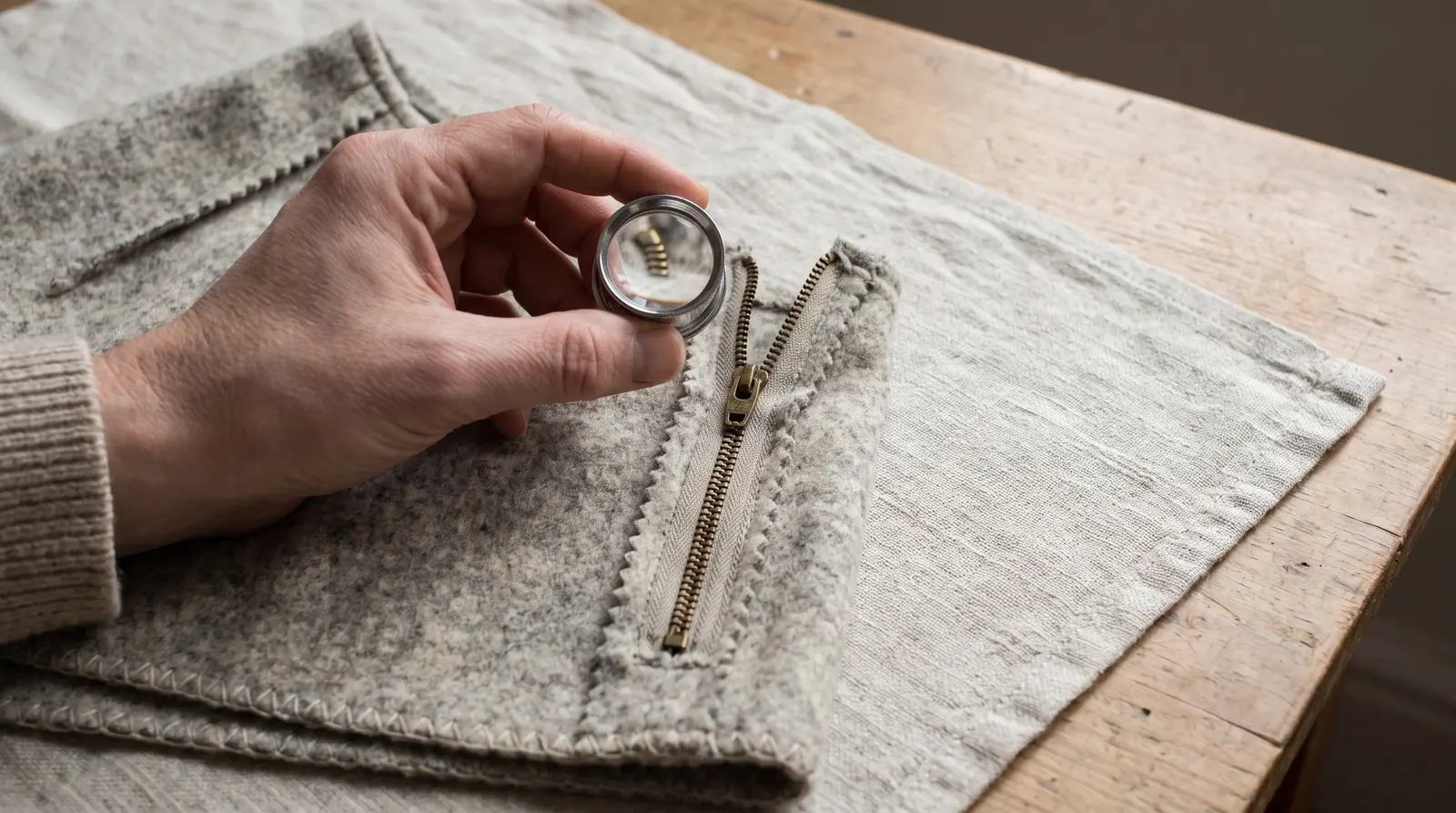
- Zippers. A Fashion Institute of Technology thesis on dating garments by zippers notes they are often stamped with the maker’s name, sometimes the country, and that their design can be roughly matched to makers and periods. Check it is the original: replaced zippers are common.
- Fabric and fiber. A fiber name that wasn’t in use yet rules out a date: lyocell only got its first FTC designation in 1992.
- Shape. Shoulder width, waist height and length follow the fashion of the time, so the cut should agree with the label.
How do you photograph vintage labels for a listing?
The short answer
Photograph every label close up, straight on and in daylight, with every word readable. Add one wider shot that shows where each label sits, and name the era clues in the description. Buyers use the label photos to check your dating, and several platforms ask for them.
The label shot list
- Brand label. Fill the frame, phone parallel to the label. Tap the screen on the lettering to focus.
- Care and content label. Both sides, if there is printing on the back.
- Size, union and RN labels. One photo each, even if they seem minor: they are the evidence for your date.
- A wider shot. The label in place in the collar or side seam, which shows it is sewn in.
- Damage to the label. Fading or fraying is part of the condition, so don’t edit it away.
Flatten a curled label with a fingertip at the edge, not over the words. Window light from the side shows the weave of a woven label; the flash flattens it and adds glare on satin. For the rest of the listing photos, see how to photograph clothes to sell.
What the platforms ask for
- Grailed lists a brand tag photo and a wash tag photo as required, if the item has them, in its photo standards guide.
- Vinted asks for close-ups of the logo, care label and stitching, and adds “Make sure any text is readable as well” (photo guide).
- Etsy may ask for more photos or information about vintage items, “such as their source, age, designer, or materials” (Creativity Standards).
How to write the era in your listing
State the range, then the evidence, so a buyer can check it against your photos:
Era: circa 1974–mid 1990s.
Evidence: red, white and blue ILGWU union label
(photo 5), care instructions in words (photo 4),
maker's address with ZIP code (photo 3).
Measurements (laid flat): see below.
Where is the best place to sell vintage clothes?
The short answer
The best place to sell vintage clothes depends on the piece: Etsy for items 20 years or older, Depop for vintage and streetwear, eBay for buyers searching by brand and era, and Grailed for menswear. Poshmark, Vinted and Mercari suit everyday vintage, and your own store keeps the margin.
| Platform | Good for | Photo rule |
|---|---|---|
| Etsy | Items “20+ years old” that you curated (Creativity Standards) | “original photos of the actual product” (image rules) |
| Depop | Vintage, streetwear, one-off pieces (Depop guide) | “Only use photos taken by yourself” (stock images) |
| eBay | Buyers who search by brand, style and era (eBay guide) | Bans “stock photos for used, damaged, or defective items” (picture policy) |
| Grailed | Menswear and designer vintage | Photos “must be your own”; brand and wash tags required (guide) |
| Poshmark | Brand-name vintage (Poshmark guide) | “your original photos”, item “clearly represented in the main photo” (seller policy) |
| Vinted | Everyday vintage (Vinted guide) | “Use your own pics” (photo guide) |
| Mercari | Everyday vintage and accessories (Mercari guide) | Bans photos “you do not own or have not taken yourself” (policy) |
If you list a one-of-a-kind piece in two places, delete the other listing the moment it sells. Fees and shipping are compared in where to sell clothes online, and sourcing and pricing in how to become a clothing reseller.
Can you show vintage clothes on a model?
The short answer
Yes, for your own store, social media and ads, and as an extra Poshmark photo after your own main one. Etsy, Depop, Vinted, Mercari, Grailed and eBay listings stay with photos you took. Check the model photo’s length, sleeves and fit against your measurements, and always show the real garment and its label close-ups too.
Vintage is often cut differently from today’s clothes, so buyers want to see how a piece sits on a body. With Tryly’s AI clothing photography, you upload the piece shot flat, on a hanger or on a mannequin, and get it back on a model in about 15 seconds.
Choose from 500+ models, bring your own model, or use yourself. Paid-plan photos can go on your store, in ads and on social media.
The test that matters
Try it on your hardest garment first.
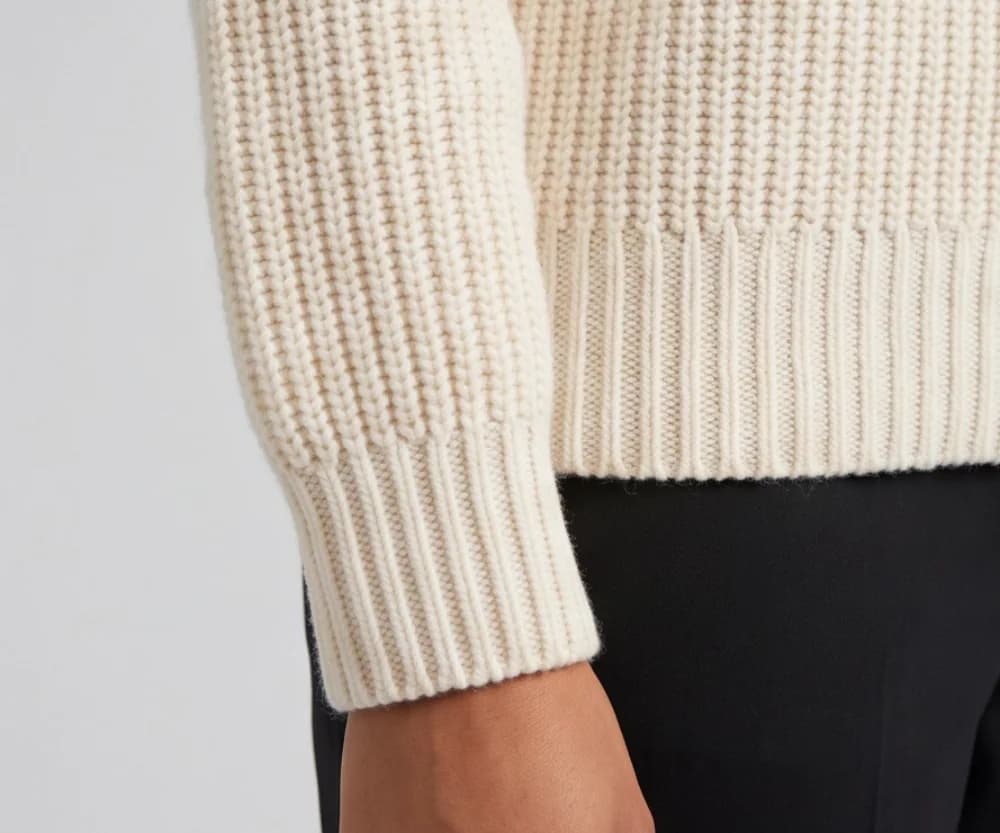
Sellers judge an AI photo tool on the piece most likely to go wrong: a print, a logo, sheer fabric or a detail that has to sit exactly right. Check the result at full size before you publish it. Here: a cream rib-knit sweater with black tailored trousers.
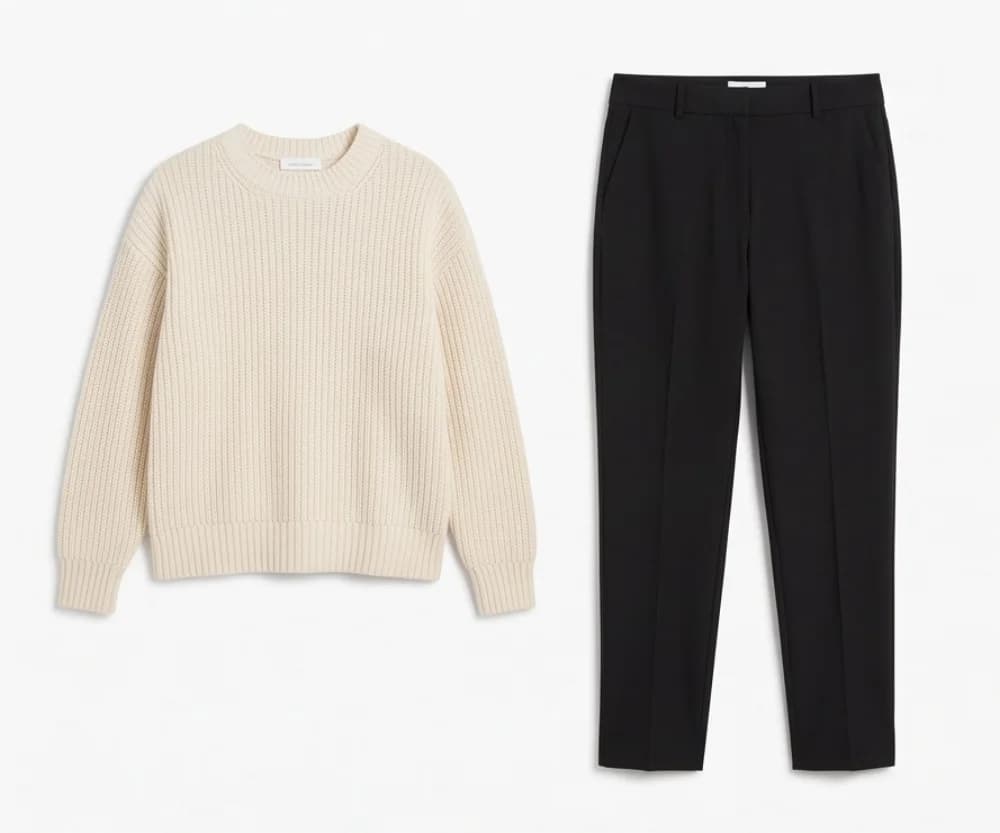
01 Product photo
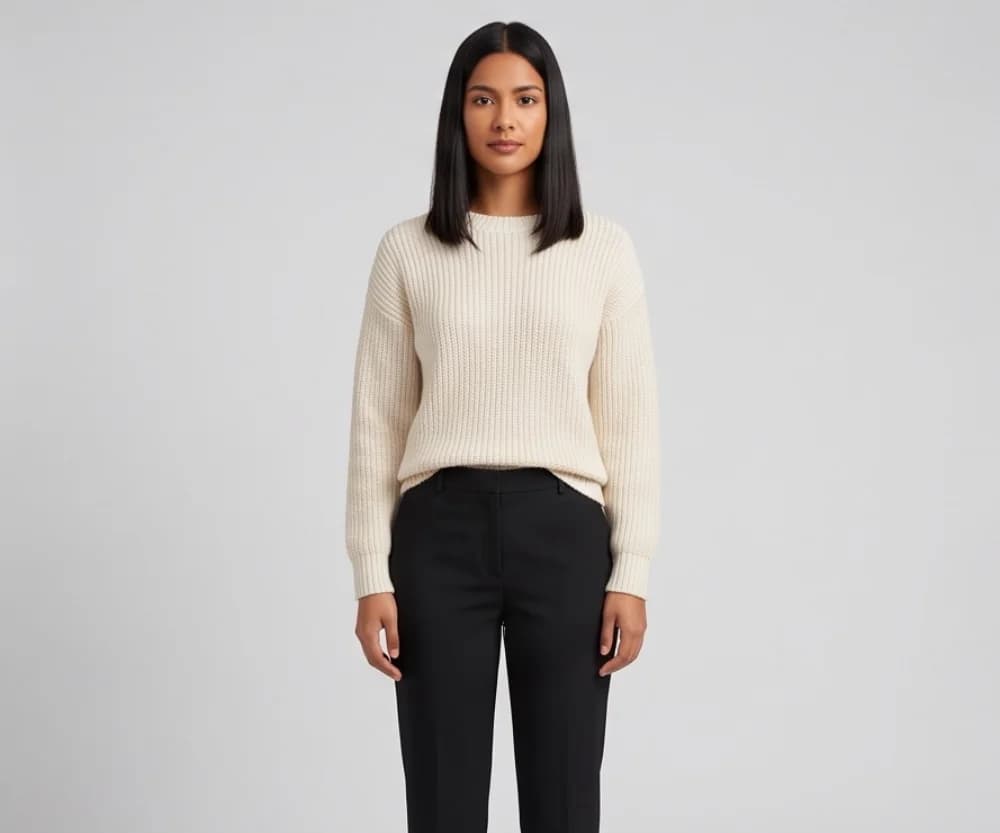
02 On the model
03 Full-size check
10 free photos, no card.
Tryly costs from $0.33 a day, from $9.99/month (Starter plan, billed annually), and as low as $0.25 per photo. At Tryly’s lowest rate, 40 vintage pieces with one worn shot each come to $10.
Vintage clothing labels: questions sellers ask
How can you tell how old clothing is by the tag?+
Read every label for clues tied to a known date: US care instructions point to after July 1972, fiber percentages on a non-wool piece to after March 1960, a five-digit ZIP code to after July 1963, and care symbols with no words to 1997 or later. The newest clue sets the earliest possible date. Give the result as a range, such as “circa 1970s”.
What does RN mean on a clothing tag?+
RN stands for Registered Identification Number, a number the FTC issues to US businesses that make, import, distribute or sell textile, wool or fur products. It identifies the company, not the year the garment was made. Search it in the FTC’s RN database, then date the piece by that company’s labels and the other clues on the tag.
When did care labels become required on clothes?+
In the US, the FTC issued its Care Labeling Rule in December 1971, and it took effect for garments leaving the factory on July 3, 1972. Words were the norm until July 1997, when the FTC allowed a set of standard care symbols in place of words.
What does CC41 mean on a clothing label?+
CC41 is the mark of Britain’s wartime Utility scheme, and stood for “Civilian Clothing 1941”. The Imperial War Museum says it became compulsory on all Utility cloth and garments in autumn 1941, and the V&A dates the scheme 1941 to 1952, so a CC41 label places a piece in those years.
Does a union label mean clothing is vintage?+
An ILGWU union label means a US-made women’s garment from before the union merged into UNITE in 1995, so yes, it is old. The design narrows it: the new label launched in 1959, was redesigned in 1963 to stress “union made”, and turned red, white and blue with “Made in the U.S.A.” in 1974.
How old does clothing have to be to be vintage?+
Definitions vary by platform. Etsy sets a clear rule: a vintage item there must be 20 or more years old and personally curated or collected by the seller. On other platforms, “vintage” is a description, so back it up with the label clues.
Where is the best place to sell vintage clothes?+
Etsy for pieces 20 or more years old, Depop for vintage and streetwear, eBay for buyers searching by brand and era, Grailed for menswear, plus Poshmark, Vinted and Mercari for everyday vintage. Some sellers list one piece on two platforms and on their own store, and buyers everywhere expect clear photos of the labels.
Written by
Elena Varga
Head of Content, Tryly Academy
Former e-commerce photo producer who ran catalogue shoots for fashion labels for over a decade. Writes the Academy’s guides.
- 11 years in fashion e-commerce
- 1,200+ catalogue shoots produced
Expert review
Sofia Moretti
Fashion photographer · Expert reviewer
Has shot campaigns and on-model e-commerce for fashion brands for 14 years. Reviews every Academy article for accuracy.
- 14 years in fashion photography
- Campaign and catalogue work across Europe
How we work: every Academy article is written by a specialist, reviewed by a working fashion photographer, and re-checked against its sources when prices or rules change.